

Ukraine hits Wildberries and Ozon hubs as Russia’s logistics crisis deepens
 Read NV on Google
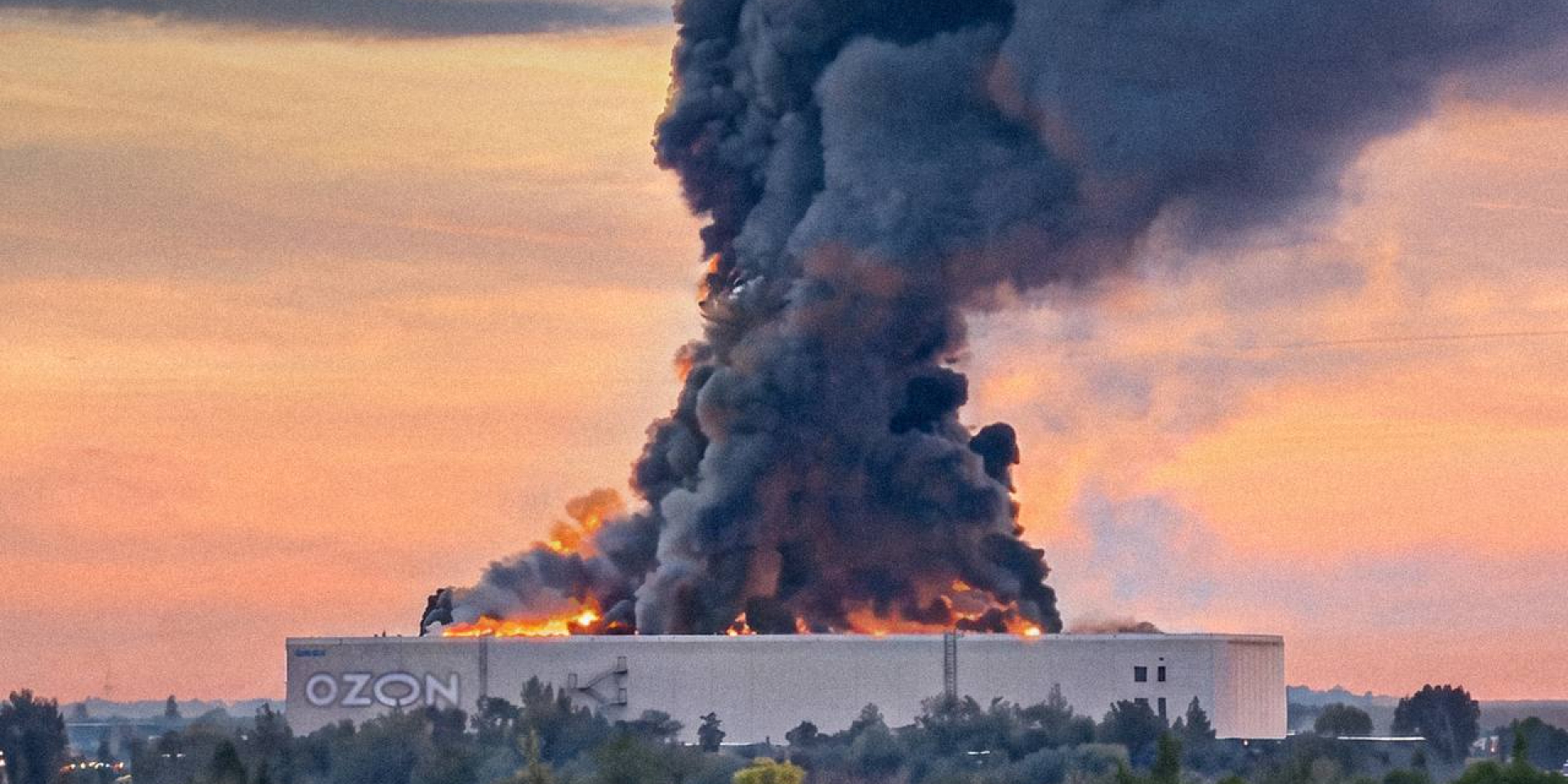
Ozon logistics hub in Russia’s Samara Oblast after a Ukrainian UAV attack on Aug. 22. (Photo: Ministry of Defense of Ukraine / Telegram)
A series of Ukrainian UAV and missile attacks on marketplace
logistics hubs across 16 Russian regions has paralyzed supply chains, triggered
legal chaos and pushed hundreds of thousands of Russian sellers to the brink of
bankruptcy.
An
Ozon marketplace warehouse is burning in Saratov, Russia. It has become a
familiar sight in the aggressor state. In July and August 2026 alone, fires,
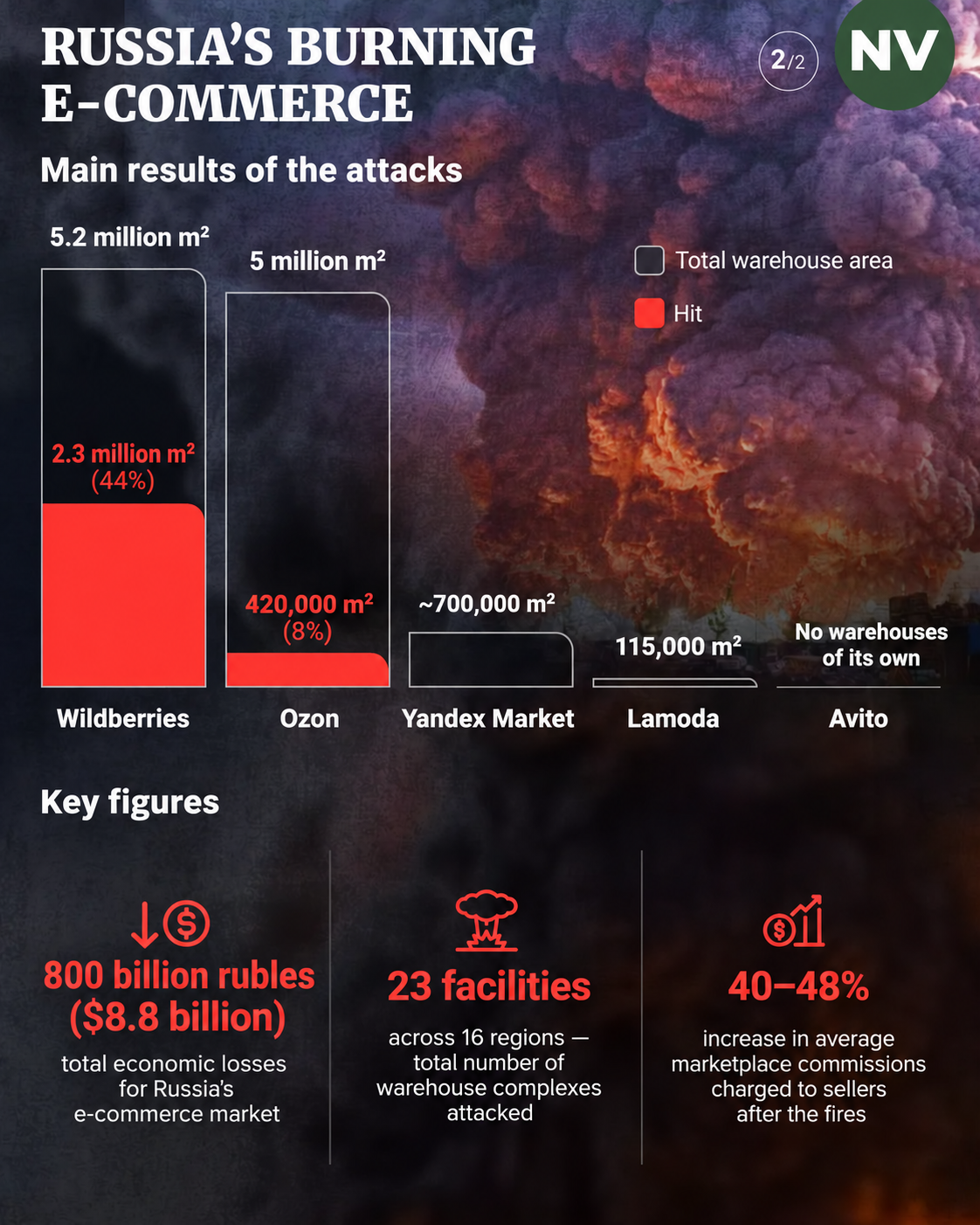
destruction and forced shutdowns knocked out 18%–24% of all warehouse capacity
operated by the market’s key players. Total economic losses to the sector
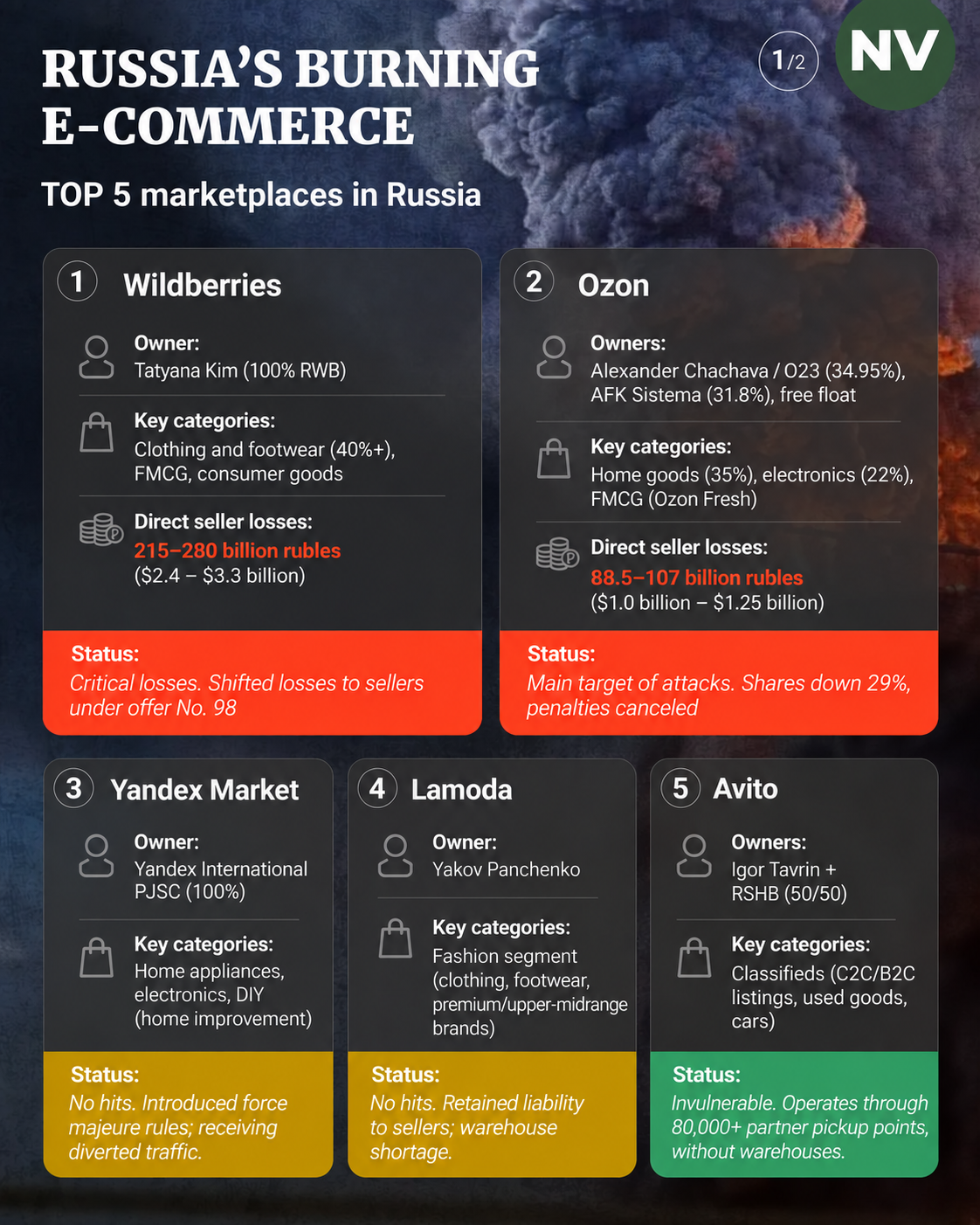
exceeded 800 billion rubles ($8.8 billion). More than 500 billion rubles ($5.5
billion) of that amount represents direct losses suffered by independent
sellers whose goods burned or became trapped at destroyed terminals.
During the first stage of the military-logistics operation,
Wildberries superhubs operated by the combined RWB group bore the brunt of the
attacks. By late August, however, Ukraine’s Armed Forces shifted
their focus to Ozon facilities, operated by Ozon Holdings. The shift to the
market’s second-largest player was a logical and consistent continuation of
efforts to destroy the enemy’s logistics network. It ultimately paralyzed the
aggressor’s main logistics routes and set off an irreversible restructuring of
the industry.
The first wave and a burning empire
Russia’s logistics collapse began with strikes on
Wildberries, whose strategy relied on enormous megahubs.
In July and the first half of August, Ukrainian UAVs knocked
out eight of the company’s 10 largest distribution centers. Complexes in
Elektrostal (250,000 square meters), Kotovsk (108,000 square meters), Koledino
(250,000 square meters) and near Samara (160,000 square meters) either burned
down completely or ceased operations. The company lost more than one-third of
its capacity, while direct infrastructure losses exceeded 200 billion rubles
($2.2 billion).
But the position taken by business owner Tatyana Kim was the
real shock for the market. Several days before the attacks, Wildberries
secretly introduced a new version of its Offer No. 98, shifting the financial
risk for property destroyed by military action onto the sellers themselves.
Company management initially refused to compensate sellers, citing force
majeure, and later, under threat of a revolt, paid small businesses a token
5%–10% of the value of their goods.
The response from the government and financial institutions
deepened the crisis. Russian government Resolution No. 1074 granted tax
deferrals only to businesses that lost more than 5% of their annual revenue.
Banks refused to write off loans and raised commercial interest rates for
affected businesses to 18%. Insurance companies widely invoked war clauses to
deny claims after the loss ratio on civilian policies covering UAV-related
damage exceeded 3,000%.
This left hundreds of thousands of entrepreneurs facing
bankruptcy.
From online bookstore to e-commerce symbol
Ozon is Russia’s oldest online retailer, operating since
April 9, 1998. The country’s second-largest marketplace began as a conventional
online store selling books and videotapes. It was founded by programmers
Alexander Yegorov and Dmitry Rudakov of the St. Petersburg company Reksoft.
The founders wanted to build a “Russian Amazon” and named it
Azon. Russian-speaking users naturally pronounced the name as Ozon.
The service’s first customers in the late 1990s were not
residents of Russia but members of the Russian-speaking diaspora abroad who
wanted Russian-language literature. Russia’s August 1998 default gave the
business a boost as Russians increasingly sought bargains online at fixed
prices.
The company raised its first $3 million from Baring Vostok
in 1999 and in 2005 built Russia’s first privately operated logistics
fulfillment center in Tver.
Ozon continued raising capital as it developed, including
through the arrival of conglomerate AFK Sistema in 2014 and its shift to the
marketplace model in 2018. In 2017, Russia’s intellectual property agency
Rospatent granted the Ozon brand “well-known trademark” status. Of 600,000
Russian brands, only 177 hold that status.
After the start of the full-scale war and its delisting from
Western exchanges, Ozon moved its registration from Cyprus to a Russian
offshore jurisdiction on Oktyabrsky Island in Kaliningrad Oblast under the name
Ozon International Public Joint Stock Company.
By the end of 2025, the platform’s gross merchandise value,
or GMV, had risen 45% to 4.16 trillion rubles ($45.9 billion), while its
assortment exceeded 500 million SKUs for 65.1 million active customers. They
generated 2.48 billion orders through more than 84,000 pickup points.
Forbes valued the Ozon brand at $13.4 billion in 2026,
making it more valuable than the combined RWB/Wildberries group at $12.6
billion, although Ozon still trails it in turnover.
Specializing in electronics (22%), home goods (35%),
clothing and rapid grocery delivery through Ozon Fresh, which ranks fifth in
the e-grocery market, the platform built a network of 50 fulfillment centers
and more than 150 local hubs stretching from Kaliningrad to Khabarovsk.
Strategic target and a week of fires
After Wildberries infrastructure was disrupted, Ukrainian
forces shifted their main focus to Ozon. The decision has a clear strategic
rationale.
Ozon is not simply a marketplace but a systemically
important publicly traded company. It supplies civilian goods to Russia’s major
cities and serves as a key technology platform for the aggressor state. Ozon
Bank, with more than 50 million customers, also handles a large share of
fintech services and payments in Russia.
Formally, the company’s two largest shareholders hold a combined
66.75% stake: venture investor Alexander Chachava, through O23, with 34.95%,
and AFK Sistema with 31.8%. Chachava bought the stake held by Vostok
Investments, Baring Vostok’s successor, for 38.2 billion rubles.
However, recent investigations found that money and
financial instruments from entities tied to Putin-linked oligarch Gennady
Timchenko were behind the Ozon share buyout deals. This turned Ozon into a
direct financial vehicle and strategic asset for the Kremlin elite.
The timeline records eight incidents involving Ozon
facilities in seven Russian regions: Tatarstan, Samara and Orenburg oblasts,
Adygea, Dagestan, Stavropol Krai and Bashkortostan. Damage or evacuations
affected more than 420,000 square meters of warehouse space, about 8% of the company’s
total infrastructure of more than 5 million square meters.
The heaviest blow hit the company’s fifth-largest hub near
Chapayevsk in Samara Oblast, covering 135,000 square meters. On Aug. 22, a UAV
strike caused the roof to collapse and more than 40 million items to be
completely destroyed by fire. Restoring the facility, valued at 10 billion
rubles ($110 million), will take 2–3 years.
The Enem complex near Krasnodar, covering 94,000 square
meters, and the hub in Makhachkala also burned.
The culmination came with the Aug. 30 missile strike on
Belgorod, when Ukraine’s Armed Forces used missiles for the first time against
the Estate Logistic warehouse terminal leased by Ozon. The strike sparked fires
in seven blocks, completely halting logistics in the region.
Ozon sellers’ merchandise losses are estimated at 88.5–107
billion rubles ($0.97–1.17 billion), while Data Insight estimates the total
economic impact of the crisis on the company at 125–170 billion rubles
($1.37–1.87 billion).
Unlike Wildberries, Ozon management did not retroactively
change its terms, cut commissions by 3 percentage points, waived storage fees
at affected warehouses and brought in Ingosstrakh to handle compensation.
That did not prevent panic. On the Moscow Exchange on Aug.
24, Ozon shares plunged 29.09% to 2,112.5 rubles, or about $23.20. The drop
wiped 177 billion rubles ($1.95 billion) off the company’s market
capitalization in a single trading session and dragged AFK Sistema shares down
11.5%.
Empty shelves and the price Russians pay
The destruction of distribution centers sharply worsened
operating conditions and logistics across Russia. Next-day delivery has
effectively disappeared.
Before the wave of attacks, customers received goods within
1–2 days. After the series of fires, average delivery times rose to 4–7 days,
while delays in Siberia, the Urals and the Far East now range from 10 to 60
days.
To offset losses, marketplaces raised commissions from the
previous 30%–35% to a critical 40%–48%. The destruction of megahubs increased
logistics costs as a share of a product’s final price from 5%–10% to 10%–20%.
At the same time, Russia’s insurance sector raised warehouse
insurance premiums five- to tenfold, to 1.0%–1.5% of a facility’s value, and
introduced deductibles of up to 250 million rubles.
These factors triggered a price surge. The elimination of
discounts and rising seller costs pushed retail prices up 10%–30%. This forced
Russia’s Central Bank to officially raise its inflation forecast to 6%–7%.
Russia’s e-commerce market is undergoing forced
fragmentation. The era of giant superhubs is over: marketplaces are urgently
building networks of smaller microwarehouses covering 6,000–10,000 square
meters each and seeking warehouse space in Kazakhstan and Belarus.
Sellers are moving en masse to alternative platforms.
Wildberries’ inbound traffic has fallen 21%, while M.Video has emerged as the
main beneficiary, with the number of new partners up 168%, using its retail
stores as warehouses.
The cost of war-related risks and the destruction of
warehouse infrastructure has fallen entirely on ordinary Russians through
product shortages, slower service and high inflation. Such an economic blow
will become a tangible factor in Russia’s fall elections, which is probably
what the Ukrainian military is counting on.
The military war may be swinging in our favor, but the information war continues.
Just as an army needs soldiers, so does a free society need its journalists to ensure that people have access to honest, trustworthy voices to understand the world around them.
For the past five years, The New Voice of Ukraine has been working tirelessly to push back against Russian narratives and defend democracy. But we cannot do it alone.
Please consider supporting us on Patreon for just $5 a month – your donation does directly to supporting journalists and ensuring that this front of the infowar says solid and defended.
Thank you.
Follow us on Twitter, Facebook and Google News
