

Oksana Solop’s Cradle of War confronts memory, violence and the future
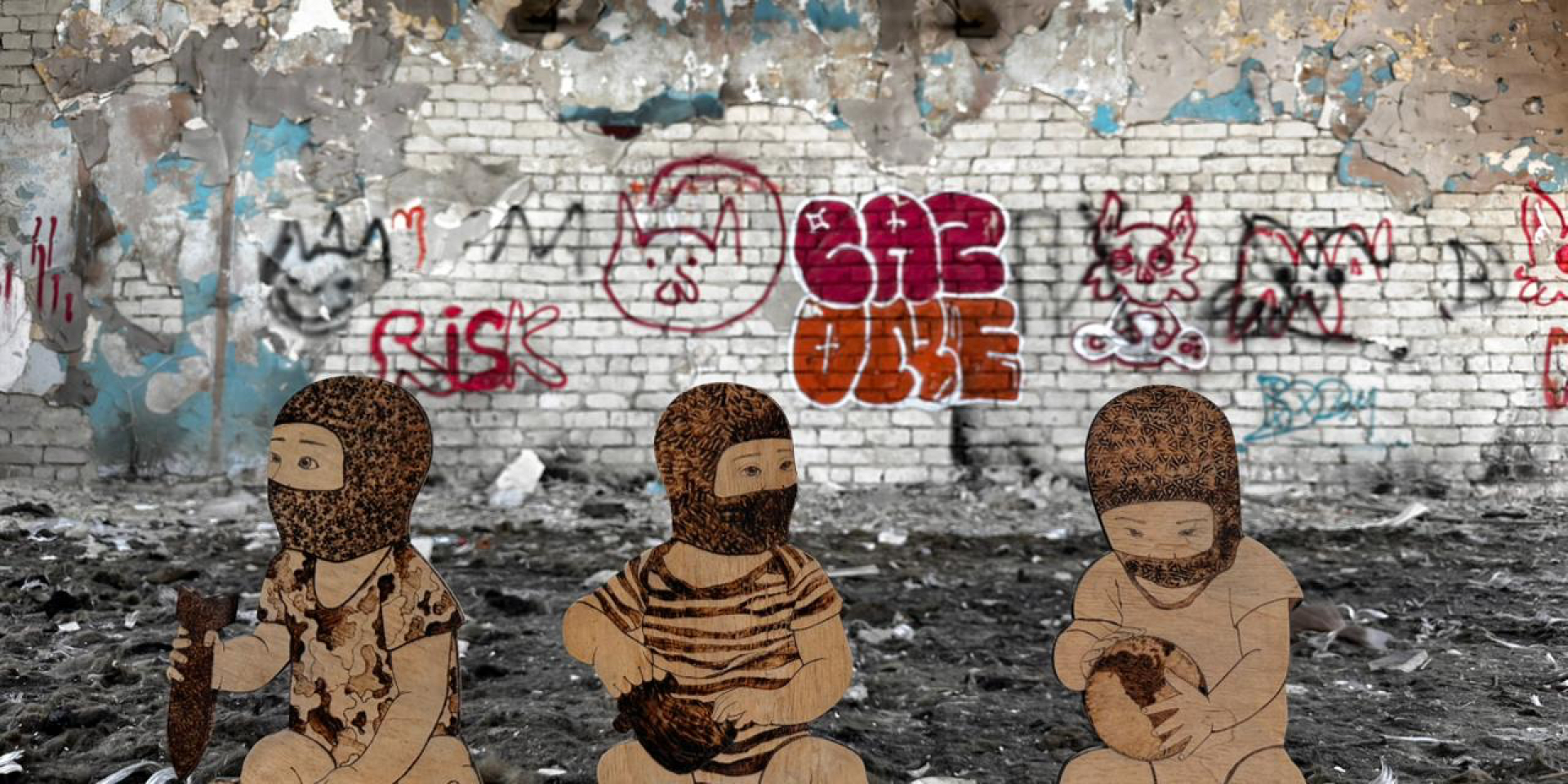
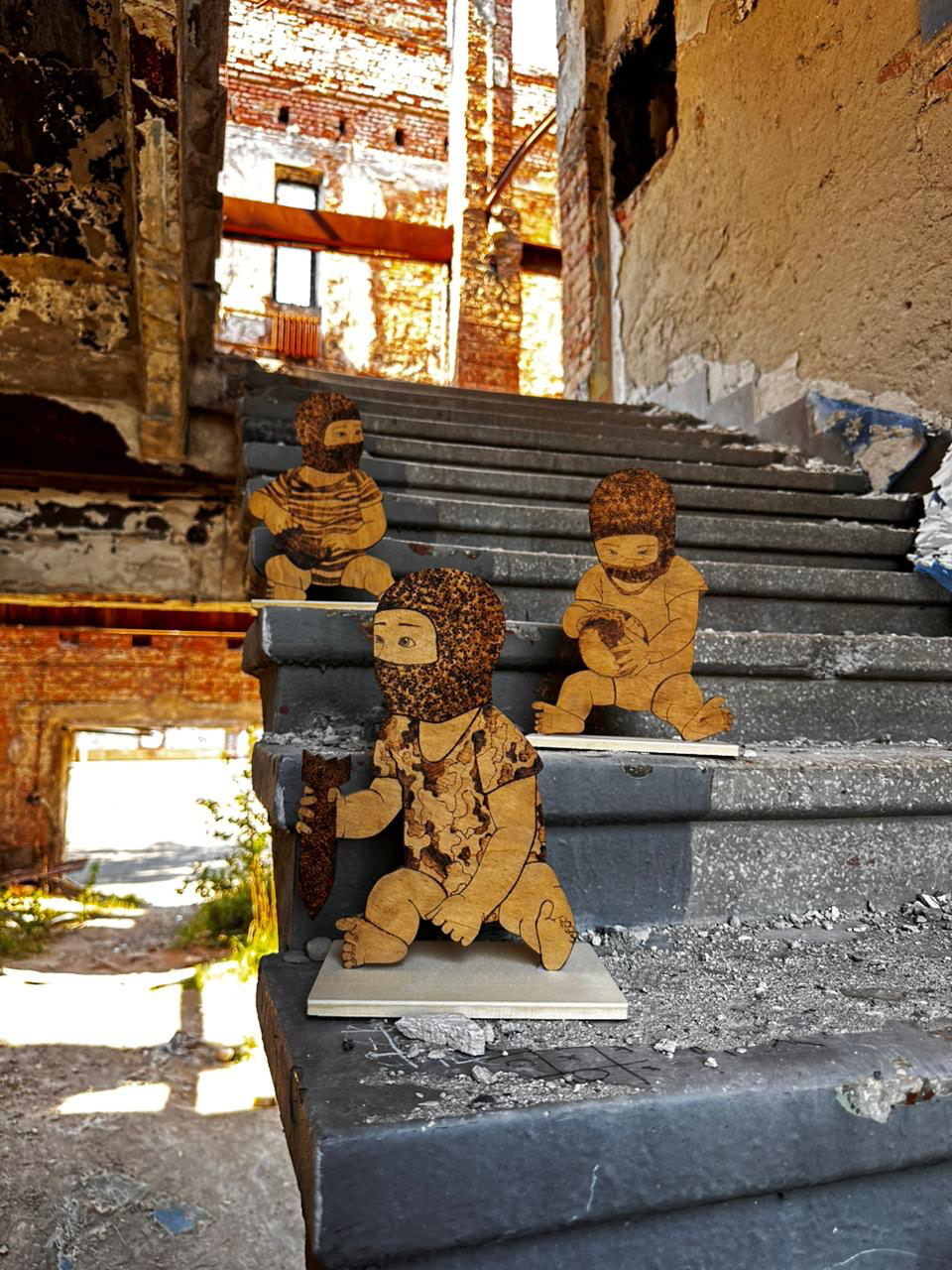
Three wooden figures from the Cradle of War project during the first intervention in the destroyed gymnasium No. 134 in Kharkiv (Photo: Oksana Solop’s Cradle of War confronts memory, violence and the future)
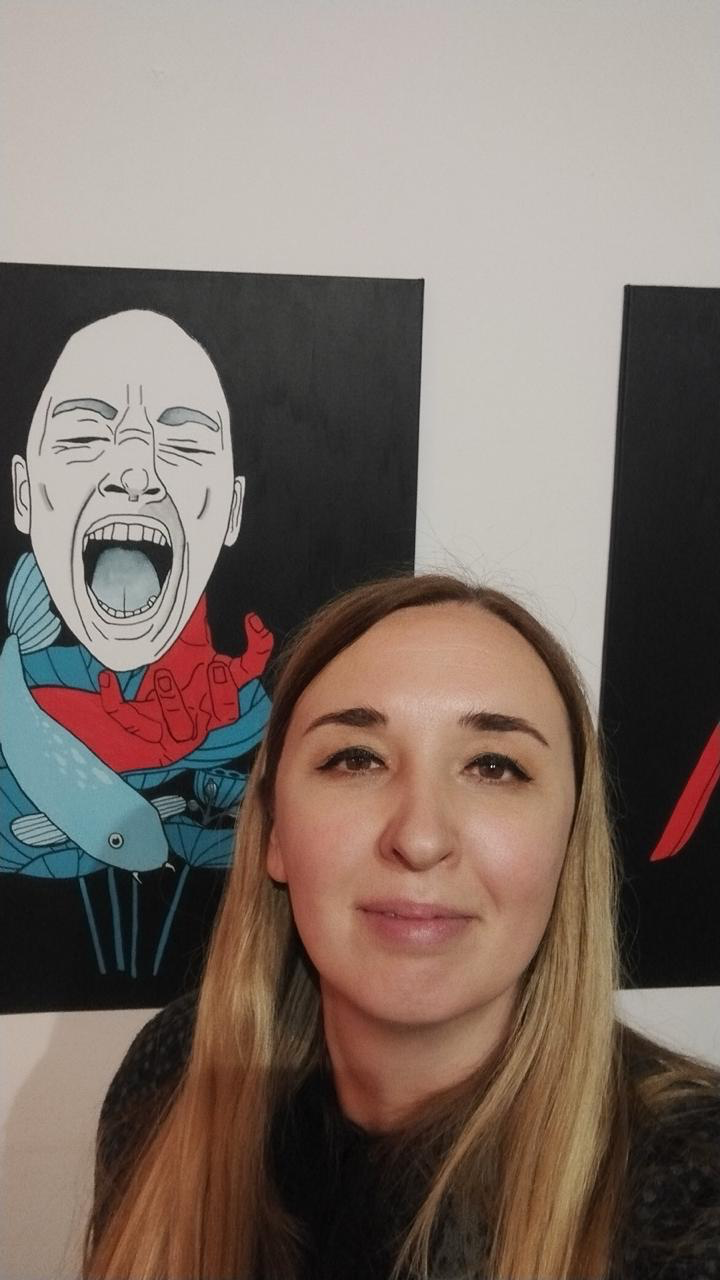
Kharkiv artist Oksana Solop spent more than three years in Austria after Russia’s full-scale invasion before returning home in the summer of 2025. In a conversation with NV English, she explains why the safety of Graz never made it feel like her place, how her art has changed, and why Cradle of War, a project she first conceived in 2014, is now becoming a conversation about what adults leave behind for the next generation.
In late August, we are sitting in Oksana Solop’s studio in central Kharkiv. There is wood and plywood, photographs, seeds, paints, tools, finished works and works still in progress. Asked to choose one object around her that she would like to begin a conversation about herself with, Solop pauses for a moment — then refuses to choose.
“Actually, every object here has its own meaning, and it’s unlikely that anything is here by accident. Everything matters. The tools, the materials — everything,” she says.
The space itself turns out to matter far more than any single object.
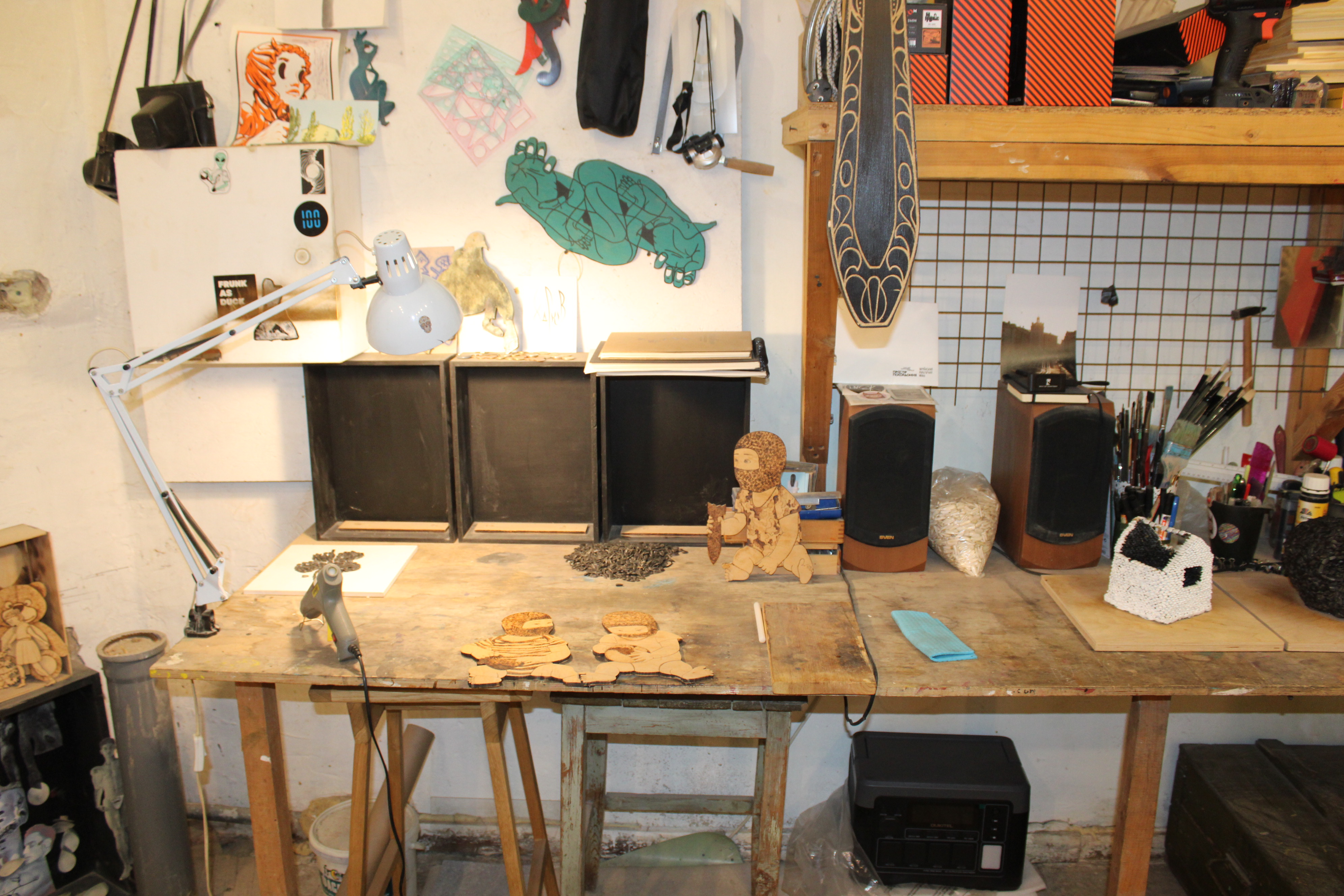
After more than three years of living in Austria, having her own studio gives the artist an almost physical sense of regained freedom. Abroad, she eventually managed to set up a small corner where she could work. But every time, she had to put everything out and then pack it away again.
Here, she does not.
“It felt like there wasn’t enough air there. Here, I feel very free. I can do whatever I want: drink coffee, smoke, paint, leave things scattered around, clean up, not clean up. I can leave everything as it is, go away and come back. It’s a space where I feel free. Everything is born here,” Solop says.
For her, that “here” means more than a room filled with artwork.
Oksana Solop was born in Luhansk and lived there until 2005. She moved to Kharkiv to study at the Kharkiv State Academy of Design and Arts, and the city gradually became her artistic home. In her biography, Luhansk remained the place of her childhood and youth; Kharkiv became the place where she developed professionally.
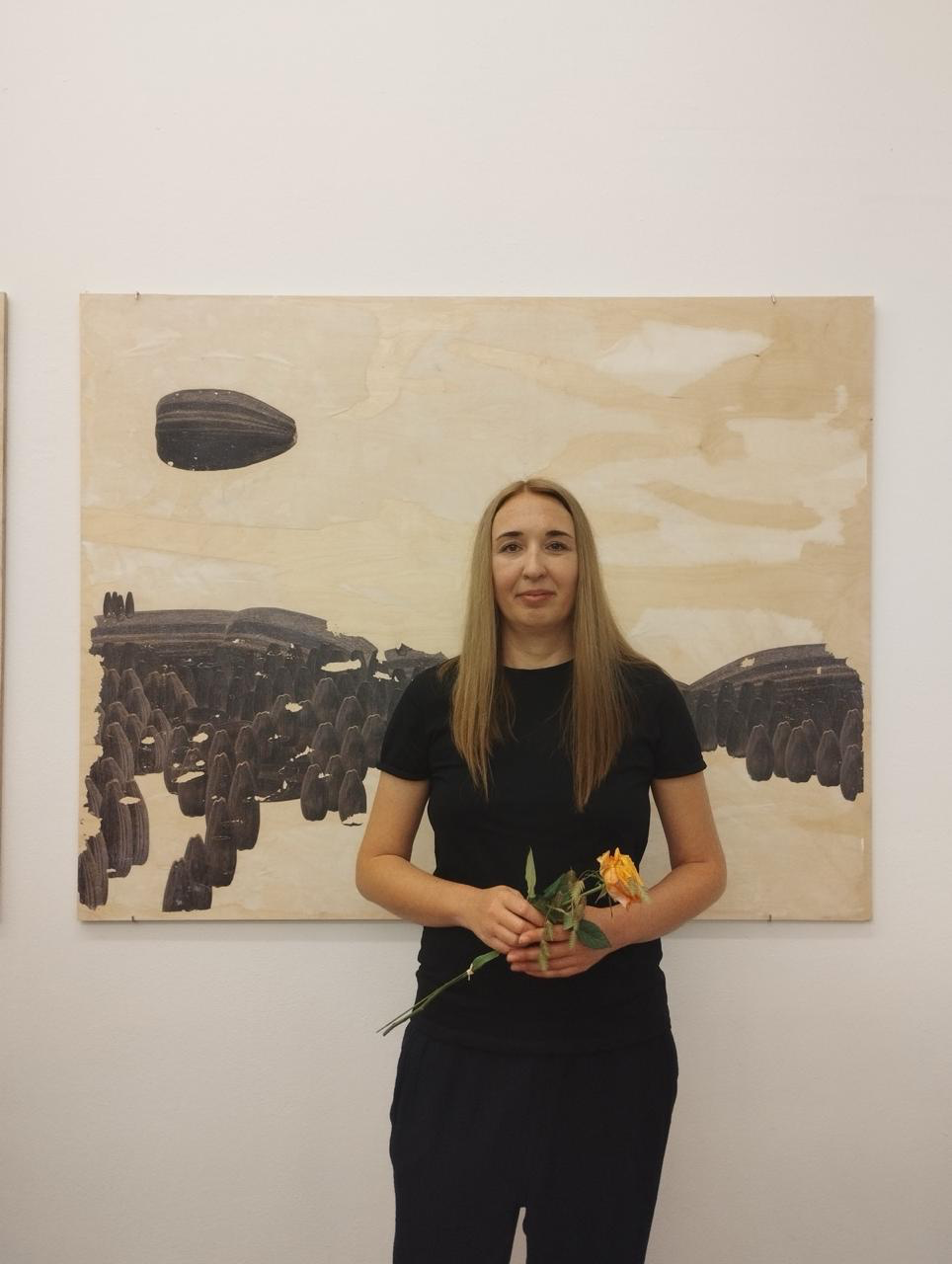
In 2019, those two geographies came together in her solo project Home Sweet Home. It was dedicated to Luhansk — a city she had not seen for years by then and one that had remained under occupation since 2014.
Solop recalls that at the time, she was trying, in a sense, to close that part of her past for herself, let it go and move on. But after 2022, Home Sweet Home began to look different.
“Now, in a way, it looks like a prophetic project,” the artist says.
Her own formula for art, meanwhile, is strikingly simple.
“My art is certain stages of my life. My experience, what I felt, thought and went through at certain moments. It is my life. A kind of chronicle of what is happening to me, and as a contemporary artist, I simply record it.”
Since 2014, war has appeared increasingly often in that chronicle. But alongside it remain the nude body, everyday scenes, relationships, home and human vulnerability.
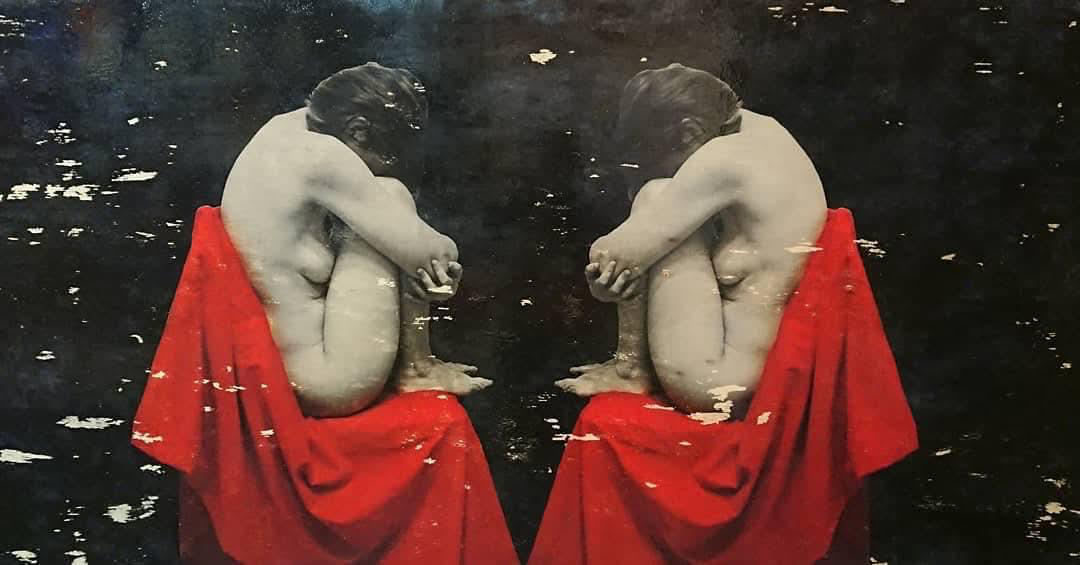
In Solop’s work, the body is less a subject than a material for capturing a state of mind. She photographs friends, asking them to move, react, close themselves off or open themselves up — then searches among the many frames for the one that carries the psychological tone she is looking for.
“For me, the naked body is not a sexual object. It is a material, like clay for a sculptor, something you can shape into something else,” she explains.
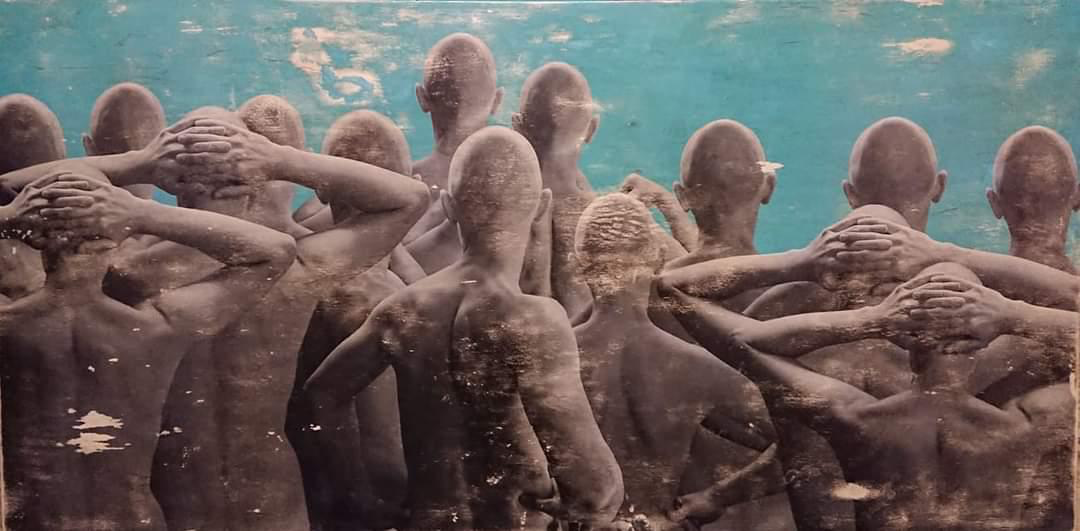
Materiality in general is important to her. Solop works with drawing, photography, collage, painting and installation, while photo decoupage on wood and plywood has become one of her characteristic techniques. The photographic image encounters the warm surface of the wood, then gets rubbed away, scratched and layered.
She did not choose plywood by accident. The coldness of photography and the warmth of wood give her the combination she wants, Solop says.
“It often turns out very unexpectedly. A little bit of magic appears,” she says.
Another material entered her practice almost as a joke.
In 2017, Solop was spending time with friends at a country house and eating seeds. A friend was supposed to join them but missed her train. Solop arranged the seeds into a heart, photographed it and sent it to her. When it became clear that the friend would not make it after all, Solop made another heart — this time from the husks.
Later, she began photographing people with seeds, scanning them and constructing images from them. In 2017, it was primarily a game, she says. By 2019, the motif had become more complex.
“I do something first, and then I start seeing meanings in it,” Solop explains.
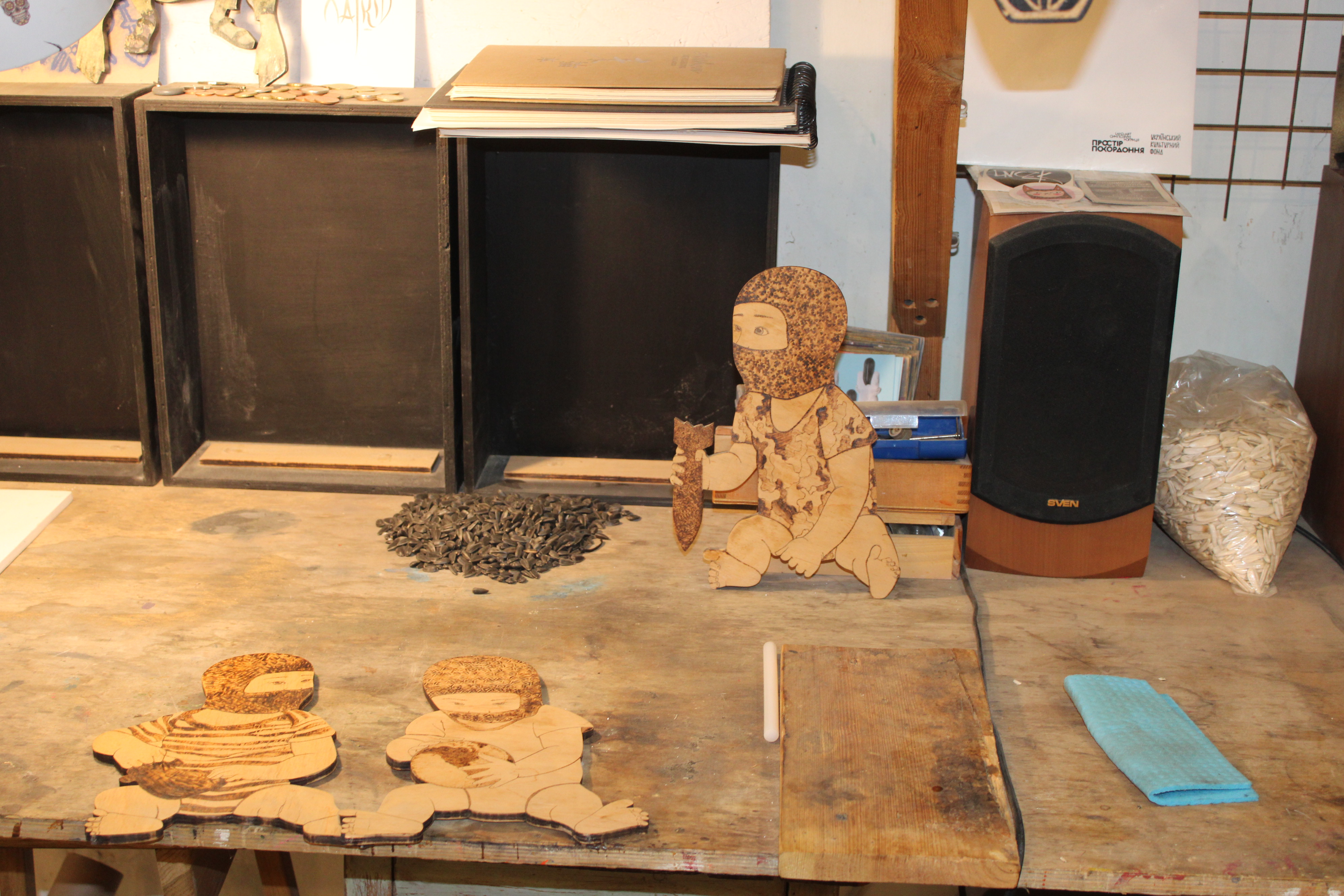
Now she is also thinking about white seeds — about moving from darkness toward light.
The reason she gives does not sound like a fully formed curatorial concept. It sounds more like a question that does not yet have an answer.
“I was noticing too much darkness around me. So much bad and evil that I started wondering: what if everything dark could become light? What would this world be like if there were no darkness? Is that possible?” she says.
It is not necessarily only about war, Solop adds. It is more an almost utopian attempt to imagine a world without evil.
Several years before this conversation, her world changed in a single morning.
At around 4:30 a.m. on Feb. 24, 2022, Solop received a call from her friend Natasha.
“She says, ‘The war has started.’ I had just woken up and didn’t understand anything. I could already hear some sounds. I say, ‘What’s the plan?’ Then: ‘Pack your things, we’ll meet at the studio.’”
She threw what she needed into a backpack and headed there.
They would spend the next 20 days in the studio.
The first instinct was to wait it out. Hide. Go outside as little as possible. Solop remembers being overwhelmed by fear. At first, they kept telling themselves: another two or three days, and it will all be over.
It wasn’t.
There was destruction nearby. It was loud. Aircraft flew overhead. Sleeping properly or taking a shower was impossible. They made quick runs outside for food. Eventually, friends drove them to the train station, and Solop took a train to Lviv.
The next stop was Graz.
She did not go to Austria with plans to emigrate, but on an invitation connected to an artistic residency. At first, it really did feel temporary. Later, she had to obtain refugee status and live in housing provided to her. What was supposed to be a short departure lasted more than three years.
Solop did not stop working altogether. In Austria, she took part in artistic projects, including Lost Land in 2022 and the HOME Residency Program in 2024. But some of the first works she showed there had actually been conceived back home: finished digital Ukrainian landscapes made from seeds were still on her laptop, and in Graz she printed and physically produced them.
So it would be wrong to describe her Austrian years as complete creative silence.
But they did not become a continuation of her old life either.
The artist describes that period primarily in terms of discomfort.
At first, when Ukrainian artists spoke about the war, people listened to them wide-eyed, in her view, without fully understanding what they were hearing. Later, once there was a great deal of art about the war, she sensed something different: audiences did not always want to see it anymore.
“I can’t speak for others. I can only speak for myself. The discomfort was always there,” she says.
To become part of the local artistic environment, Solop believed, she would have had to integrate into it more deeply and adapt more to what was happening there. Many Ukrainians did just that and stayed.
She stresses that she does not judge either those who left or those who returned.
“Everyone has their own experience. From my own experience, I can say: it doesn’t work for me. It’s not mine.”
There was also an internal pause.
Solop does not attribute it only to displacement. She speaks about her personal state, medical treatment and general exhaustion. But the war remained constantly present, even from hundreds of kilometers away.
“You are constantly anxious, even if you have gone far away. You worry about those who stayed. You follow everything, watch, read, talk to people. You are still inside the context. There is so much of it that it was difficult to reflect on anything.”
The most precise word for those years, in her telling, is waiting.
First, waiting for the moment when she could return.
Then came the realization that all of this was going to last.
People around her would say: it is not time yet, you need to wait.
“And you live in this state of waiting. Suspended. I never wanted to stay there,” she says.
In the summer of 2025, Solop returned to Kharkiv.
She describes the first feeling after returning as catharsis.
“There is nothing more important in the world than being where you want to be. Where you did everything, arranged things, built things and lived your life. And when you are deprived of that, you feel as if you are in a desert: you keep walking and walking, but where are you going?”
Returning brought an almost physical sense of relief, Solop continues.
“God, it finally happened. It’s an incredible happiness. You want to kiss every centimeter, every piece of this land. You cry because you really love it and want to be here — despite everything.”
There is a paradox in this that she makes no attempt to hide.
Graz was safer.
Kharkiv continues to come under attack.
During our conversation, the war is not historical context — it remains part of the city’s present.
But when asked why it is easier for her to return to work here, Solop lists very concrete things.
Her own space.
Not a dormitory.
The language.
Her people.
Her environment.
“You feel freer,” she sums up.
The Kharkiv she encountered after returning had changed too. Some people had left, and part of the artistic scene, she says, seems to have gone underground.
But it has not disappeared.
Solop mentions YermilovCentre and says that in some respects, the city’s cultural environment has been operating with even greater intensity since 2022.
She has no hesitation in placing herself within the Kharkiv artistic tradition — because of the academy, the city itself and the harder-to-define “Kharkiv vibe,” which she describes as a certain brutality, independence and sharpness.
But with her return, the scale of her own work is changing as well.
Until now, much of Solop’s art has emerged from the private sphere: the body, psychological states, relationships and personal memory. She remains cautious about attempts to speak on behalf of the “collective” and admits that throughout her life she has tried to untangle the narratives embedded in people from childhood.
It is here that one of her old ideas unexpectedly converges with the experience of recent years.
The project is called Cradle of War.
Solop first conceived it in 2014, after Russia began its war against Ukraine and events unfolded in her native Luhansk Oblast. At the time, it existed as sketches.
The central question was much harsher than it is today: How do small children grow into adults capable of starting wars?
“Back then, I put a slightly different meaning into it. The question was: how do these little children grow into such monsters who start wars?” she recalls.
More than a decade has passed.
The full-scale invasion, Kharkiv in 2022, Graz and her return have changed both the artist and the project.
“Now I’ve rethought it a little. This is already a broader problem that doesn’t exist only in our country. The project has matured into what it is now,” Solop says.
The first three physical figures already exist.
They are small wooden children, barefoot and shown in natural childhood poses. They wear balaclavas over their heads. One holds an object resembling a missile or shell, another holds a heart, and the third holds the Earth — a globe.
Here, war enters the space of childhood play alongside fundamental things: humanity and the world itself.
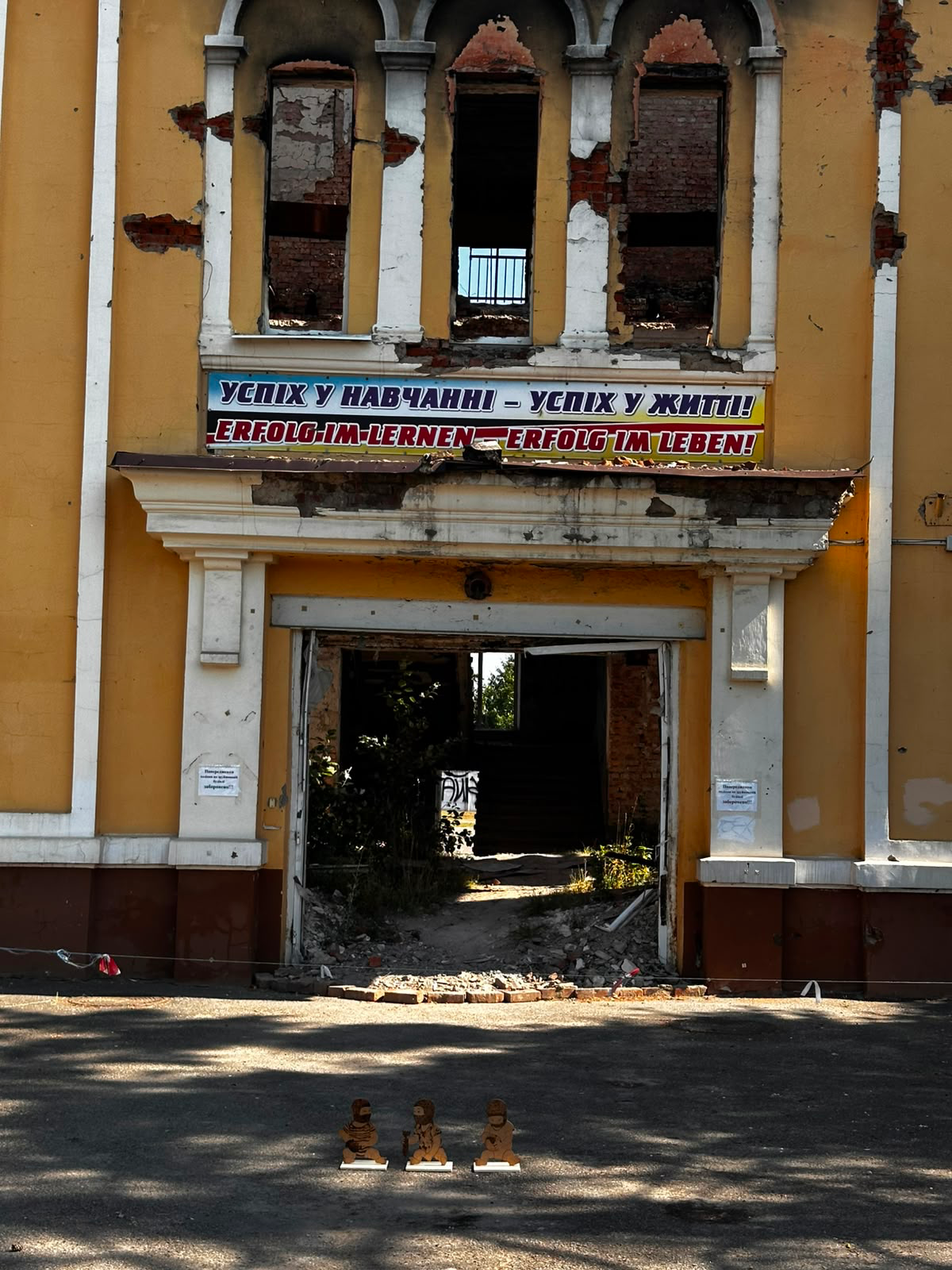
Solop staged the first intervention with the figures in a Kharkiv school damaged by Russian strikes.
In the photographs, the three small figures sit in front of a huge, shattered building. Its windows have been blown out, brick walls exposed, debris piled beyond the entrance.
Above all of it, the school’s slogan still hangs:
“Success in education means success in life!”
In other images, the children in balaclavas appear inside the building: on damaged staircases, among rubble, beneath an old basketball hoop, against walls covered in graffiti.
The location stops being a backdrop.
A school is a place where adults are supposed to prepare children for the future.
Here, the school itself becomes material evidence of the future the adult world has already placed before them.
Within the concept of Cradle of War, the children are deliberately shown at a moment before choice.
They are not yet heroes or criminals.
They have saved no one and killed no one.
They have simply inherited a world created before them.
For Solop, this is a question of inheritance.
“It’s about memory and the transmission of memory — as an inheritance. What is passed down from generation to generation. How we are raised, what is put into us. Toys matter too. So much is instilled in us from childhood,” she says.
The three objects take this conversation in different directions.
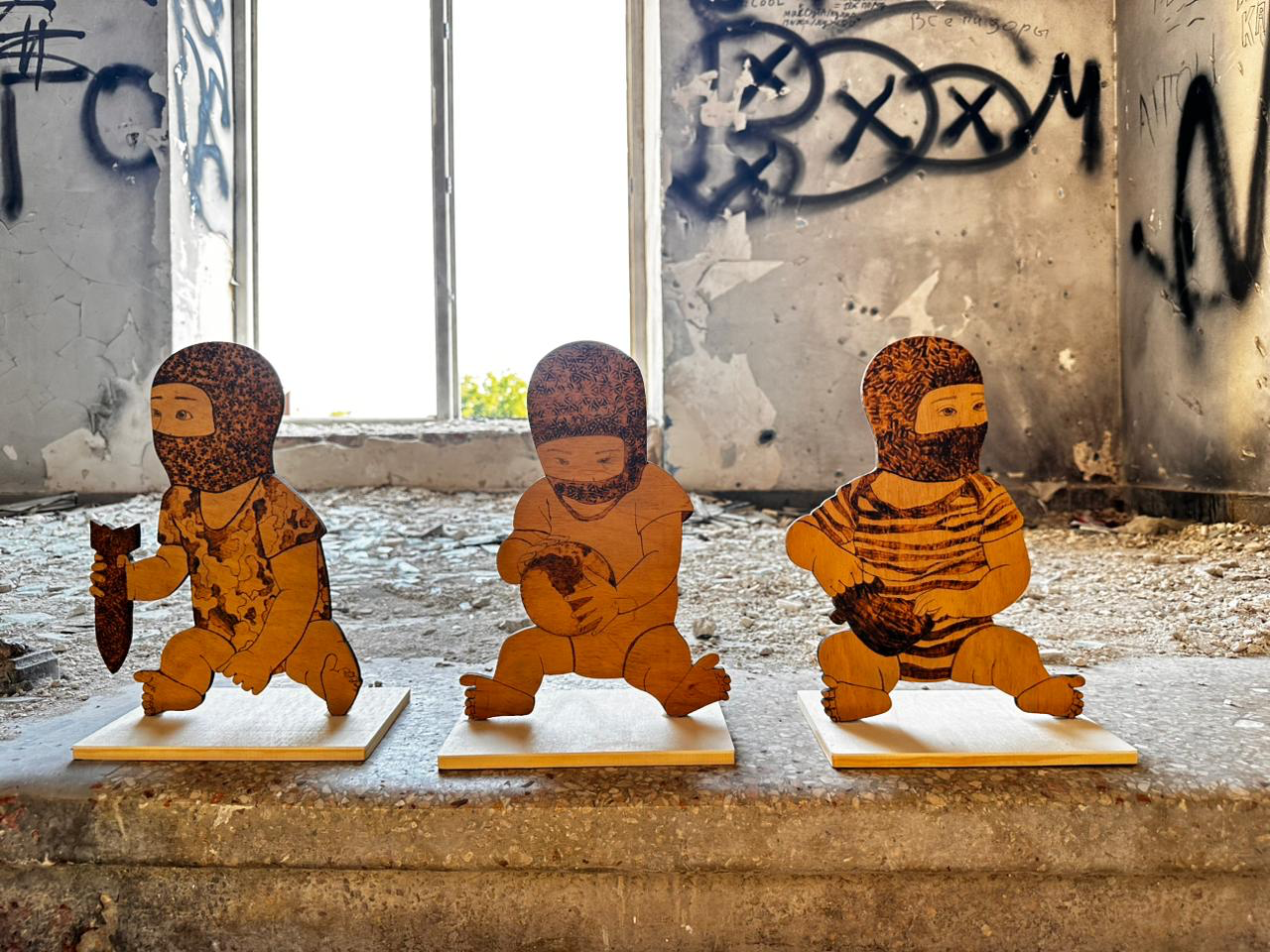
The Earth is about humanity’s relationship with the environment, with the planet people inhabit and simultaneously destroy.
The heart is about relationships between people — the ability to care for, disregard or use one another.
The missile or shell is directly about war and the way it enters even a child’s game.
The globe adds another meaning: the child becomes an image of humanity’s continuation, of the future itself.
War then looks not only like violence against another person, but also like a mechanism through which humanity repeatedly threatens its own continuation.
The project is meant to grow.
Solop wants to create new figures and stage site-specific interventions with them in Ukrainian locations damaged by Russian attacks, while developing photography into a separate layer of the work.
In the future, the figures could represent children from different backgrounds, races and continents, and the project itself could move beyond Ukraine.
At the same time, the Ukrainian experience is not supposed to dissolve into an abstract idea that “all wars are the same.” The Russia-Ukraine war remains the reality from which Solop is speaking today.
On the backs of the figures, she plans to burn in the names of wars humanity has fought over at least the past century.
The viewer will first see a child.
To see the history that child already carries, they will have to walk around the figure.
That physical movement contains one of the project’s most precise images: first comes birth, and only afterward comes the inheritance that existed long before you.
In the project’s original concept, Solop frames it as a question: Why does humanity pass on the memory of violence so easily, while the memory of peace is so difficult to preserve?
Cradle of War does not yet have a predetermined final form — and the artist does not want to artificially impose one on it.
“I give this project the freedom to choose how it wants to live,” she says.
Start with a small intervention.
See what happens next.
Make the figures larger.
Add new ones.
Take the project beyond Ukraine.
Allow its surroundings and collaboration with other artists to change it.
In this sense, Cradle of War really does differ from much of Solop’s earlier work.
She still begins with her own life — Luhansk, Kharkiv, war, departure and return — but now moves outward from the personal body, toward history, society and what one generation consciously or unconsciously passes on to another.
War, Solop believes, will remain inside Ukrainian society far longer than the fighting itself.
“It will leave many traumas, scars, wounds. And the memory will stay with us for a long time too. Maybe more than one generation will have to live through it,” the artist says.
Around us in the studio are once again the wood, tools, works and seeds — the things from which, at the beginning of our conversation, Solop refused to choose a single most important object.
“Everything is born here,” she said then.
Cradle of War, too, is still only being born in its new form.
And Solop does not offer the viewer an answer as to what it should become.
She leaves a question.
“What will we, as human beings, leave in the cradle for the next generation? A heart or a bomb? Love or war?”
The military war may be swinging in our favor, but the information war continues.
Just as an army needs soldiers, so does a free society need its journalists to ensure that people have access to honest, trustworthy voices to understand the world around them.
For the past five years, The New Voice of Ukraine has been working tirelessly to push back against Russian narratives and defend democracy. But we cannot do it alone.
Please consider supporting us on Patreon for just $5 a month – your donation does directly to supporting journalists and ensuring that this front of the infowar says solid and defended.
Thank you.
Follow us on Twitter, Facebook and Google News
