

Energoatom chief explains how Kakhovka dam explosion affects safety at Zaporizhzhya nuclear plant
Petro Kotin, head of Ukrainian nuclear operator Energoatom, explained how the shallowing of the Kakhovka water reservoir is affecting the safety of Ukraine’s Russian-occupied Zaporizhzhya Nuclear Power plant (ZNPP) in an interview to NV on June 13.
“Even if the Kakhovka water reservoir is completely drained, the Zaporizhzhya NPP has sufficient water levels in its cooling pond — the water does not drain there,” he said.
“Of course, when the Kakhovka water reservoir is completely drained, the difference between the water level in the Kakhovka water reservoir and our cooling pond will increase. And at the same time, the pressure from our pond on the walls surrounding it will increase, some seepage of this water from the pond will take place and it will shallow up to a height of 13 meters, the so-called dead volume.”
It will be impossible to turn on the ZNPP’s reactors at this water level, since the level needed to operate the circulation pumps used for normal operation is 16 meters, Kotin noted.
“The fact is that we have only theoretical calculations, no one has checked them in reality, so now we’ll see how it looks in practice. Theoretically, with such an external emergency, with the loss of the water level in the Kakhovka water reservoir, if the units were working, they could still continue to work for about one and a half months, according to safety calculations. After that, they would have to be stopped, and after the halt, they can remain in this state with this pond for about 12 years.”
Kostin emphasized that a separate issue is the safety system for the pool basins.
“This is a separate system on the ZNPP’s territory, which is currently used to cool fuel in both reactors and spent nuclear fuel holding pools,” the official said.
“This is actually what is critical for security, not even the Kakhovka Reservoir, not the pond, but the safety system pool basins. These basins maintain the water level and they are fed, including, from the Kakhovka water reservoir. But there are also other ways to feed them if necessary.”
Thus, there is no direct threat to the ZNPP, Kostin added.
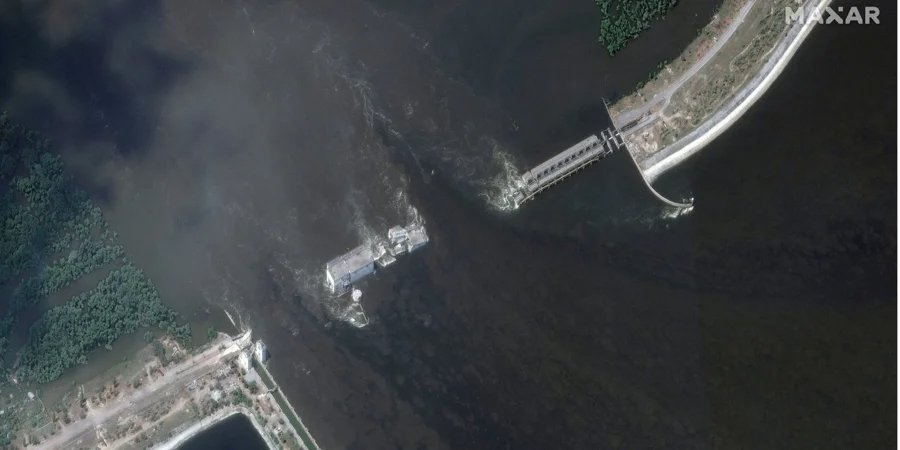
The cooling pond for the ZNPP, which supplies water to the cooling systems of nuclear reactors, has become noticeably shallower on satellite images, the Schemes investigative journalism project reported on June 12.
The current water levels in the pond are enough to sustain the plant for up to a year, Energoatom stated, noting that it is currently searching for alternative methods to top off the pond’s water levels. The operator added that, barring further destruction by the Russian forces around the plant, there is currently no risk of accident.
International Atomic Energy Agency head Rafael Grossi said on June 12 that he was immediately leaving for Ukraine, given the heightened risks around the ZNPP. However, he postponed his trip on June 14 until “it becomes safer.”
Ukraine’s Main Intelligence Directorate previously said that Russia’s destruction of the Kakhovka Dam increases the threat of a nuclear disaster.
The military war may be swinging in our favor, but the information war continues.
Just as an army needs soldiers, so does a free society need its journalists to ensure that people have access to honest, trustworthy voices to understand the world around them.
For the past five years, The New Voice of Ukraine has been working tirelessly to push back against Russian narratives and defend democracy. But we cannot do it alone.
Please consider supporting us on Patreon for just $5 a month – your donation does directly to supporting journalists and ensuring that this front of the infowar says solid and defended.
Thank you.
Follow us on Twitter, Facebook and Google News
