

Moscow plans mass deployment of cheap Dan-T cruise missiles by 2027
 Read NV on Google
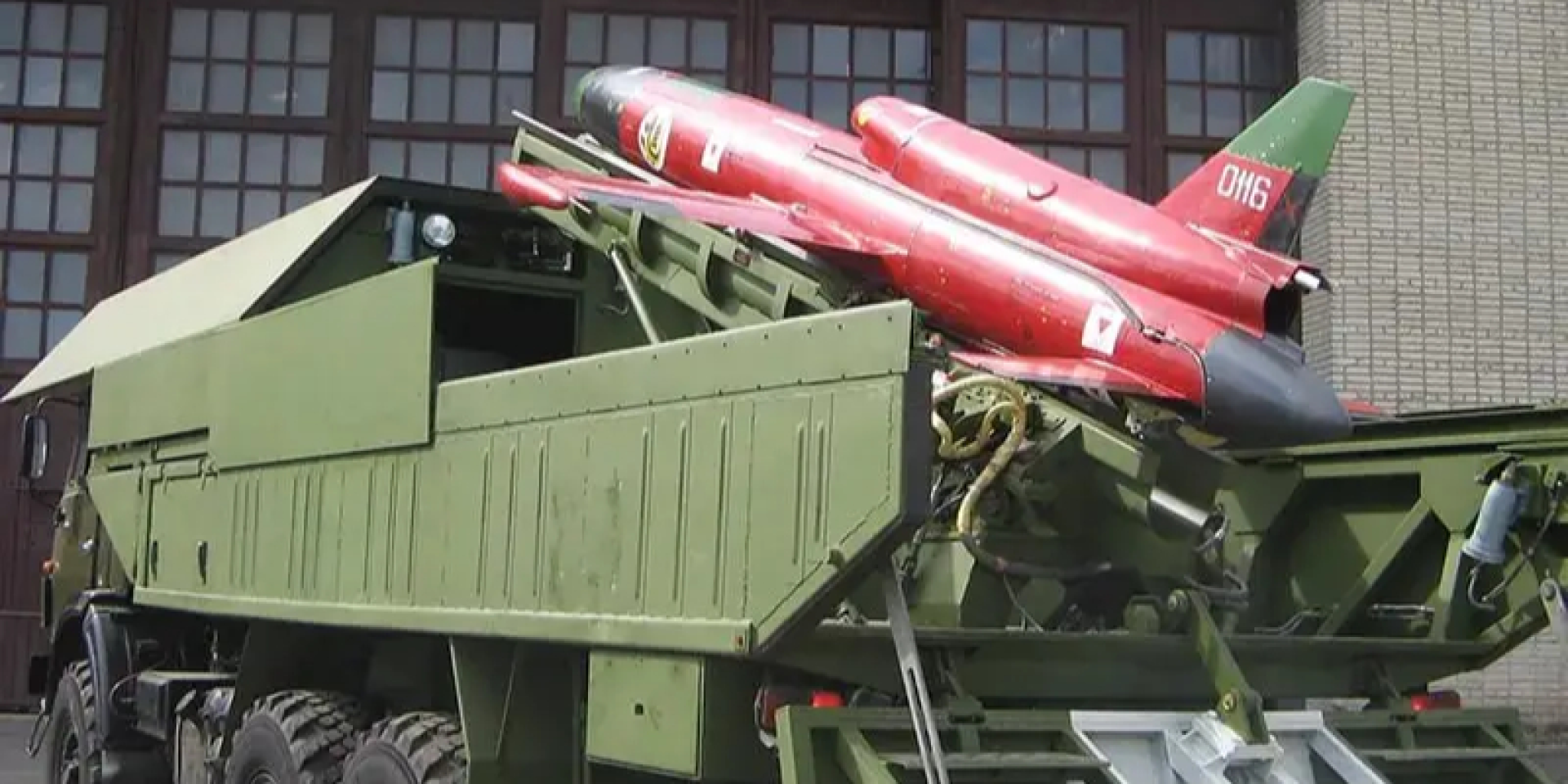
Dan-M aerial target drone, which Russia previously used to train anti-aircraft crews, later became the prototype for the new Dan-T missile (Photo: Военный осведомитель / Telegram)
Russia may shift to the mass employment of cheap Dan-T cruise missiles against Ukraine by 2027.
Military analyst and defense veteran Dmytro Putyata, known on X as Kriegsforscher, suggested that Ukraine will face "a large volume of problems" by 2027 stemming from mass-produced, low-cost Russian cruise missiles.
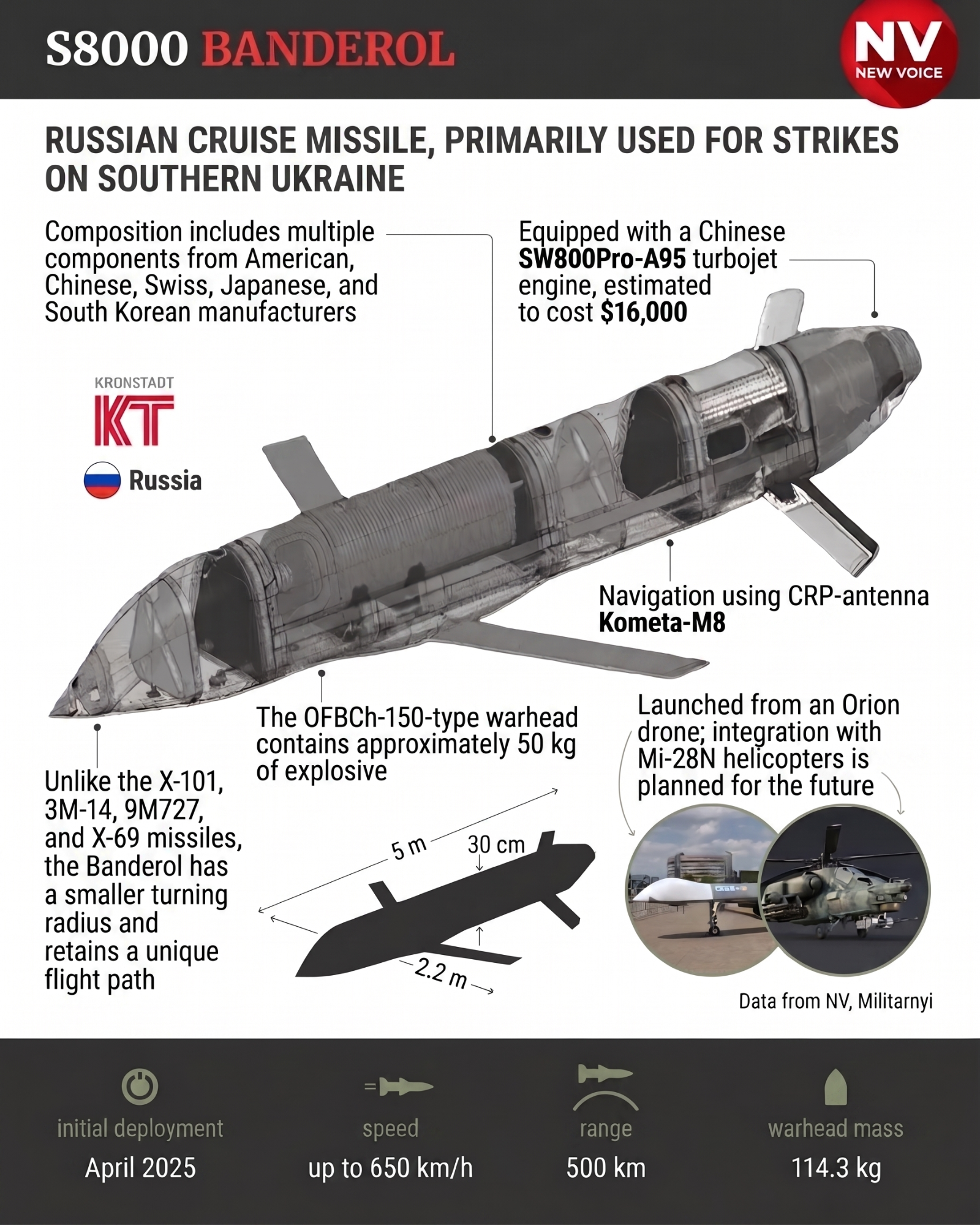
Putyata highlighted several emerging systems, including the jet-powered Banderol miniature cruise missile (also classified as a loitering munition), the fighter-launched S-71K Kover and S-71M Monokhrom missiles deployed by Su-series jets, and the "promising" Dan-T cruise missile.
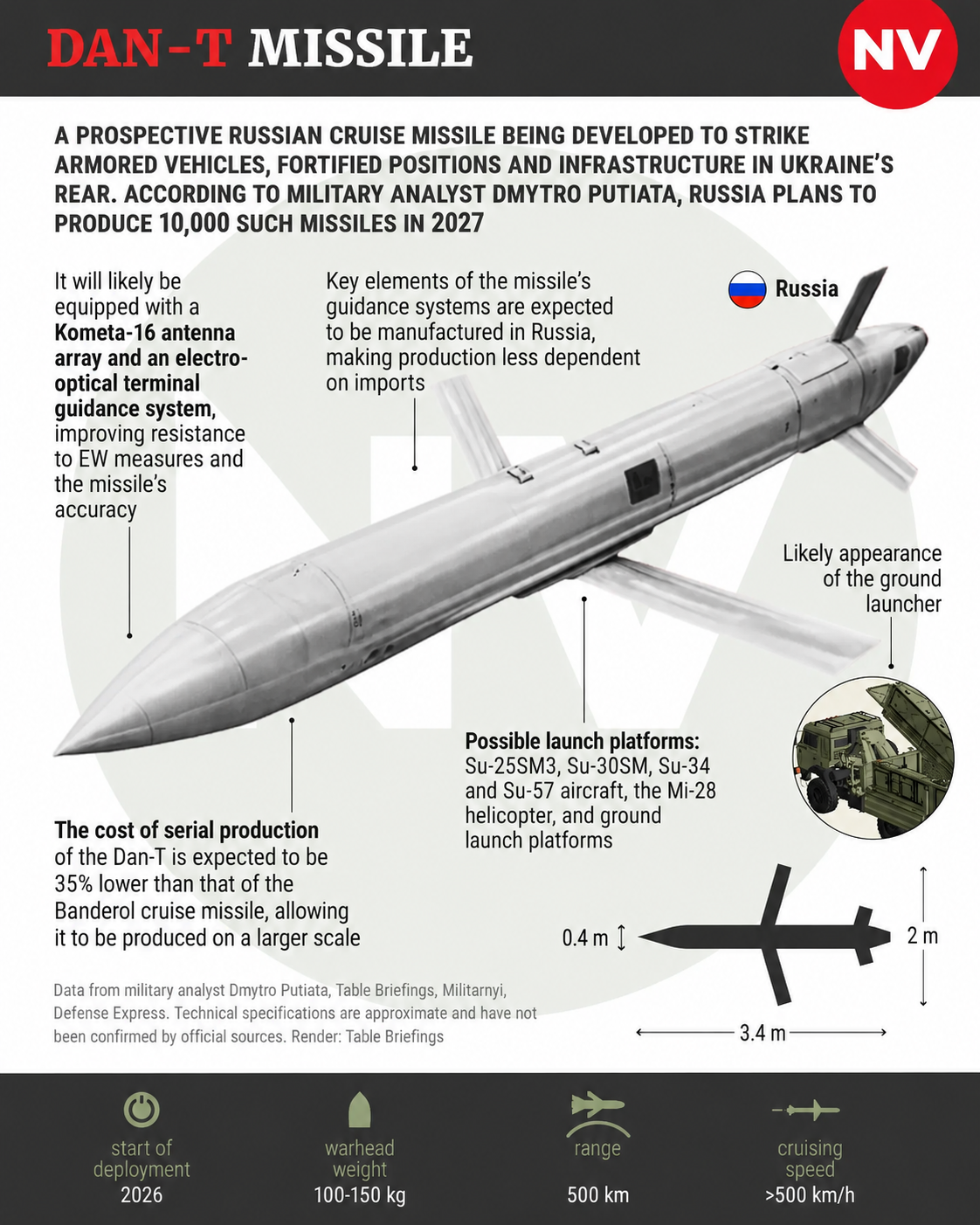
The analyst claimed that Russia allegedly plans to manufacture around 10,000 Dan-T missiles alone in 2027, though Ukrainian military intelligence has not officially confirmed this production target. According to Putyata, as of August 2026, Russian forces can launch the missile from ground launchers and multiple aerial platforms, including Su-25SM3, Su-30SM, Su-34, and Su-57 jets, as well as Mi-28 attack helicopters.
Unofficial specifications indicate the Dan-T has an operational range of approximately 500 kilometers (310 miles) and carries a 135-kilogram (298 lb) warhead. By comparison, the modernized Geran-4 and Geran-5 jet-powered drones field 90-kilogram payloads.
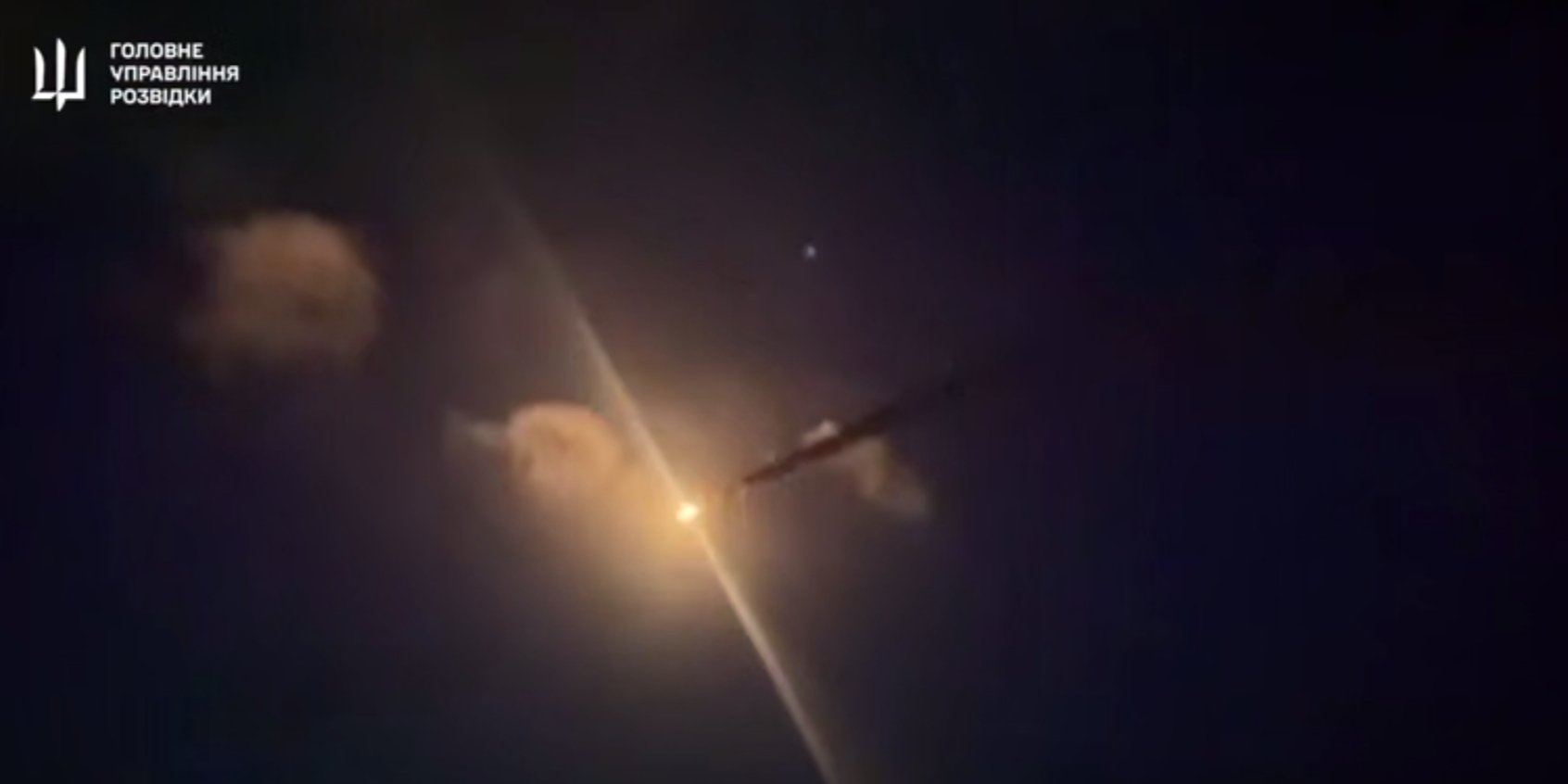
Major General Vadym Skibitskyi, Deputy Chief of Ukraine's Military Intelligence (HUR), also referenced the Dan-T in an interview with RBC-Ukraine in early August.
Skibitskyi identified the Banderol and Dan-T as novel systems deployed by Russia this year, characterizing both as "loitering munitions launched from helicopters." He added: "They are now working on launching them from fixed-wing aircraft."
HUR deputy chief emphasized that Moscow is attempting to achieve full domestic component substitution for the Dan-T, contrasting it with the Geran-4 and Geran-5, which rely on turbojet engines procured from China.
"One of the primary objectives set for the Dan-T is ensuring its entire component base is domestically sourced," Skibitskyi stressed.
Defense outlet Militarnyi reported that the Dan-T is engineered to strike armored vehicles, fortified field positions, and light infrastructure. Its technical profile mirrors the S8000 Banderol missile-drone, which Russian forces launch with increasing frequency from Mi-28 helicopters and Orion medium-altitude long-endurance UAVs.
According to Table.Briefings, Russia is integrating an upgraded guidance kit alongside the Kometa-16 antenna array to shield the missile's navigation suite from electronic warfare (EW). The outlet added that the it will likely cost 35% less than the Banderol, making it an economical replacement.
Dan-T is a direct strike conversion of the Dan-M aerial target drone, which Russia previously used to train anti-aircraft crews, explained Anatoliy Khrapchynskyi, a defense industry executive and reserve officer in Ukraine's Air Force.
Because Dan-M targets were equipped with recovery parachutes for repeated training runs, Russian engineers modified the airframe for combat by removing the parachute system and the Luneburg lens — a device used to artificially amplify radar cross-sections during drills.
In May 2025, military tech specialist Serhii "Flash" Beskrestnov reported the first documented operational test of a Dan-M target drone repurposed as a one-way attack UAV against Ukraine, drawing comparisons to Ukraine's wartime conversion of Soviet Tu-141 Strizh reconnaissance drones.
However, Khrapchynskyi described projections of 10,000 Dan-T missiles being produced next year as doubtful, noting that the missile uses the MD-120 turbojet, of which Russian factories produce only a few dozen annually. He suggested Russia might attempt to circumvent this bottleneck by substituting Iranian or Chinese engines.
Assessing the threat: analyst insights
Aviation expert Valerii Romanenko, a senior researcher at the State Aviation Museum, categorizes Banderol and Dan-T as "ersatz cruise missiles"—simpler, cheaper analogues to standard long-range cruise missiles.
Their primary operational danger stems from Russia's capability to mass-produce them at scale due to suppressed unit costs, Romanenko told UNIAN.
"What are the baseline specifications for this weapon class? The unit cost is markedly lower than a standard cruise missile like the Kh-101 or Kalibr. Operational range is capped around 500 kilometers, unlike the Kh-101's 5,500 kilometers. Warhead payload sits around 100 to 150 kilograms, and half the components — including the engine — are Chinese. Banderol, Dan-T, and new S-71M Monokhrom all fit this profile," Romanenko said.
Khrapchynskyi echoed this view, noting that both the Dan-T and Banderol reflect Moscow's broader tactical doctrine: fielding vast quantities of inexpensive jet-powered munitions capable of exhausting and saturating Ukraine's integrated air defense umbrella.
Addressing potential countermeasures, Romanenko noted that Ukrainian air defenses will counter them within an integrated framework. Fighter jets and dedicated anti-drone interceptors capable of matching jet speeds will serve as the primary defensive assets.
"Once an incoming aerial threat clocks speeds between 400 and 500 km/h [250–310 mph], fighter aviation becomes the most viable countermeasure. Interceptor drones must also play an active frontline role," Romanenko concluded.
The military war may be swinging in our favor, but the information war continues.
Just as an army needs soldiers, so does a free society need its journalists to ensure that people have access to honest, trustworthy voices to understand the world around them.
For the past five years, The New Voice of Ukraine has been working tirelessly to push back against Russian narratives and defend democracy. But we cannot do it alone.
Please consider supporting us on Patreon for just $5 a month – your donation does directly to supporting journalists and ensuring that this front of the infowar says solid and defended.
Thank you.
Follow us on Twitter, Facebook and Google News
