

Ukraine’s operation Cobweb against Russian bombers - New video
A new video detailing the chronology of Operation Cobweb’s attacks on four separate military bases across Russia was posted by Ukraine’s Security Service (SBU) on Telegram on June 11.
The operation was meticulously planned over the course of a year and a half. First, FPV drones were delivered to Russia, followed later by modular wooden houses with special hidden compartments for the drones.
The SBU stressed that the operation was a response to Russia's missile attacks on Ukrainian cities, hospitals, and energy infrastructure.
We “will beat the enemy even where it considers itself unreachable,” said SBU chief Lt. Gen. Vasyl Maliuk.
"According to the laws and customs of war, we hit legitimate targets: military airfields and aircraft that bomb our peaceful cities. So we are actually demilitarizing Russia.”
On June 1, 41 aircraft, worth an estimated $7 billion, were targeted with 117 first-person-view (FPV) kamikaze drones hidden inside trucks in coordinated attacks on the Belaya air base in Irkutsk Oblast of Siberia, the Dyagilevo air base in Ryazan Oblast in western Russia, the Olenya air base in the northern Murmansk Oblast, and the Ivanovo air base in the central Ivanovo Oblast.
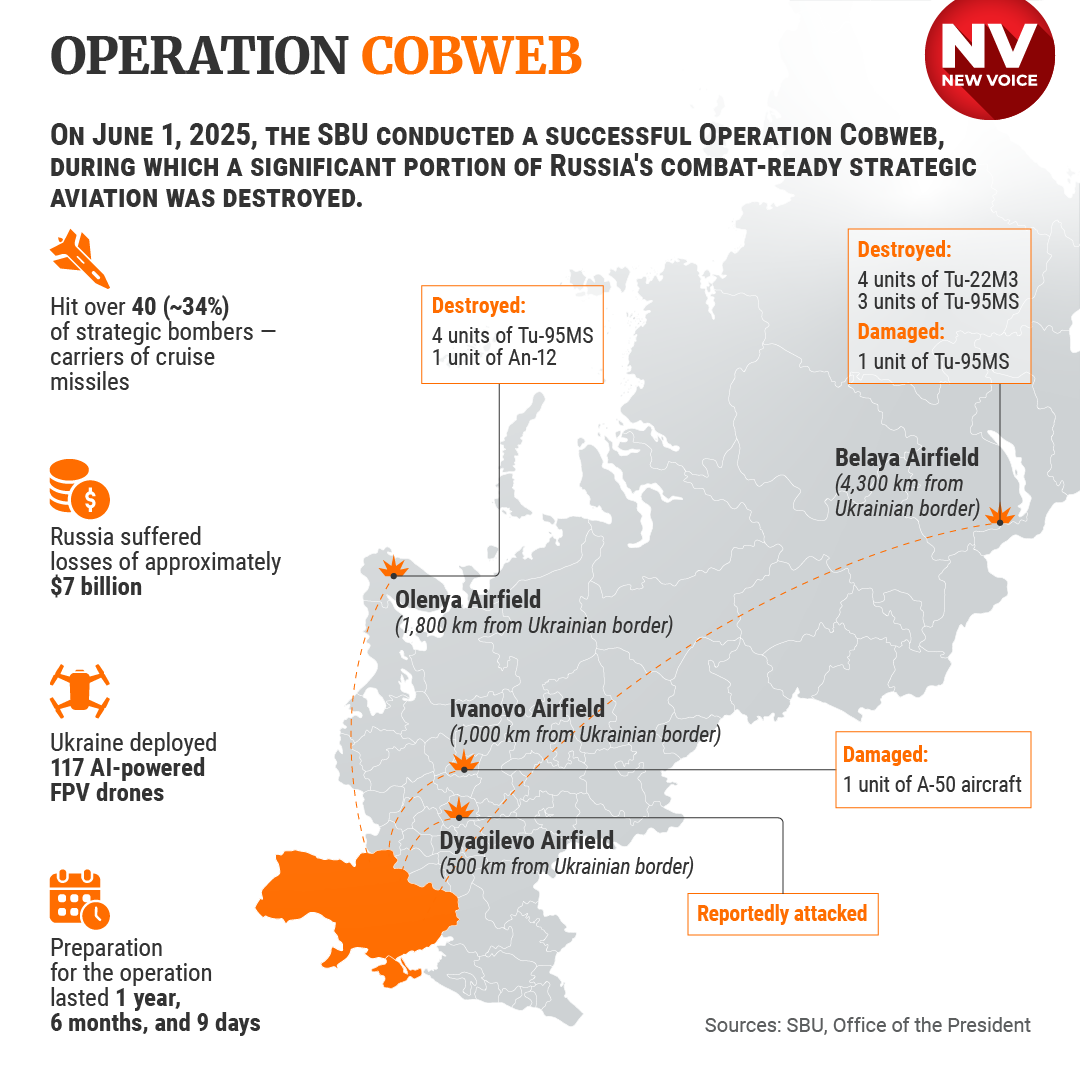
"In total, 34% of Russia's strategic cruise missile carriers at its main airfields were destroyed. This was not just a devastating blow to enemy aircraft, but also a slap in the face to the power and terrorist nature of the Russian Federation,”
The operation took place simultaneously in three time zones and was extremely complex logistically.
Russia has long ceased production of these aircraft and cannot replace the destroyed ore damaged ones. Only around 100-120 Tu-95s and Tu-22Ms remained before the attack, and only about a third of them are believed to be airworthy. These aircraft are vital for Russia's regular bombing raids on Ukraine.
The operation was carried out exactly 29 years to the day after Ukraine handed over dozens of its strategic bombers to Russia, along with up to 2,000 strategic nuclear warheads and 176 intercontinental ballistic missiles (ICBMs) in exchange for a promise by Russia and the West not to be attacked, under the Budapest Memorandum.
The military war may be swinging in our favor, but the information war continues.
Just as an army needs soldiers, so does a free society need its journalists to ensure that people have access to honest, trustworthy voices to understand the world around them.
For the past five years, The New Voice of Ukraine has been working tirelessly to push back against Russian narratives and defend democracy. But we cannot do it alone.
Please consider supporting us on Patreon for just $5 a month – your donation does directly to supporting journalists and ensuring that this front of the infowar says solid and defended.
Thank you.
Follow us on Twitter, Facebook and Google News
