

Russia’s spy hunt is paralyzing state institutions and weakening Putin’s rule
 Read NV on Google
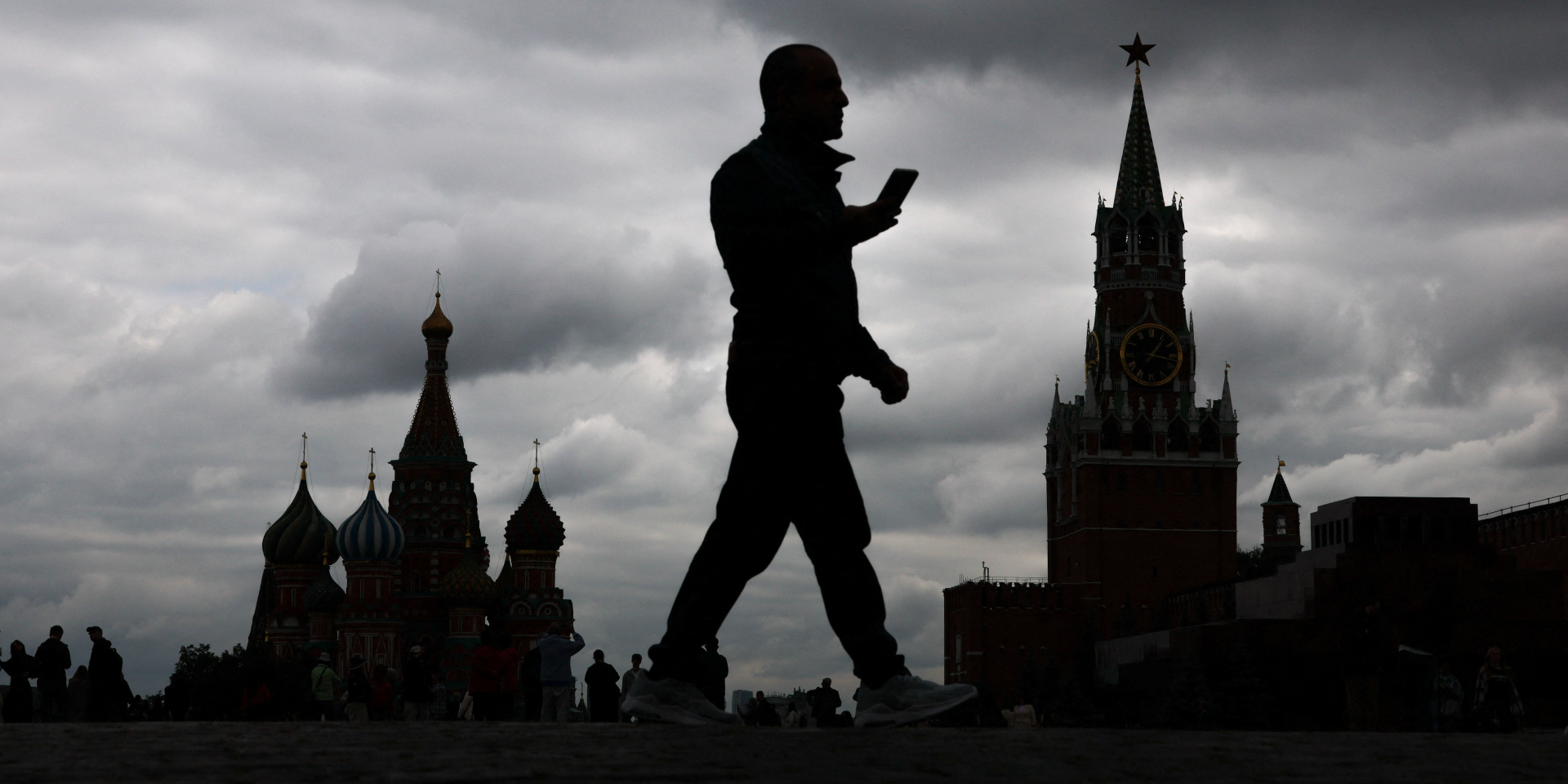
A man walks through Red Square in Moscow, Russia, on Aug. 27, 2026. (Photo: REUTERS/Ramil Sitdikov)
As the war
against Ukraine drags on, the Kremlin has found it necessary to adopt a
more aggressive strategy to control both potential opponents and ordinary
Russians. But governing through spy hunts and paranoia carries serious
consequences.
Foreign
Affairs examines how Russian dictator Vladimir Putin’s paranoia is
paralyzing Russia.
The article’s authors note that since Russia launched its
full-scale invasion of Ukraine, the Kremlin has steadily tightened its control
over Russian society. For Russians, the new measures stand in sharp contrast to
the limited freedoms they had before February 2022.
Less obvious, however, is a fundamental shift in Russia’s
domestic security doctrine, Foreign Affairs writes. The Federal Security
Service, or FSB, is now focused on hunting spies. Using tactics tested during
the Soviet era, it has carried out a campaign to root out any threats to the
regime. This has allowed the FSB to extend its reach deeper into society,
private companies and government institutions.
But governing through spy hunts and paranoia carries
significant costs, the authors argue.
Government agencies and private businesses, fearing FSB
repression, conceal accurate data, avoid making decisions and increasingly
operate in survival mode. Among ordinary Russians and civil servants, tighter
social controls and treason prosecutions have created a pervasive atmosphere of
distrust and deepened the sense of paralysis.
Ultimately, the Kremlin’s ability to govern the country
could be undermined, the authors believe.
In seeking to turn any perceived political threat into a
potential act of treason, Moscow relies not on legal standards but on secret
FSB assessments. Against that backdrop, Russian officials, members of the elite
and private organizations are increasingly reluctant to disclose information
about facts or developments that could prove politically unpopular.
The situation is further complicated by Russian industry’s
ties to the military, Foreign Affairs notes. Private companies involved in
military projects are subject to counterintelligence scrutiny. Cost overruns or
delays can bring the threat of treason charges.
Russian research institutions are also reluctant to share
information. Even innocuous data, such as technical findings, research results
or statistics, are now treated as potential security threats.
Strict oversight by the security services has also sharply
restricted the publication of even routine statistics.
The Kremlin has achieved its immediate political goals, but
at a high cost. Officials fail to report problems before they grow into crises.
Regional authorities avoid taking initiative until they receive direct orders.
Researchers, statistical agencies and businesses withhold information that
could be useful to the authorities. Civil servants across government delay
effective decisions while waiting for instructions “from above,” the
publication writes.
For the Kremlin, the risk of elite paralysis is real and is
spreading among senior officials and managers both in Moscow and the regions.
By dismantling channels of feedback, Putin’s regime is becoming increasingly
unable to understand the true state of affairs in the country, the authors
conclude. Over the long term, that could leave Putin significantly more
vulnerable to a serious political crisis.
On Aug. 7, Bloomberg reported that concern was growing among
members of Russia’s elite that the FSB
had spun out of control, as Russian dictator Vladimir Putin relies on the
agency to preserve his rule.
The military war may be swinging in our favor, but the information war continues.
Just as an army needs soldiers, so does a free society need its journalists to ensure that people have access to honest, trustworthy voices to understand the world around them.
For the past five years, The New Voice of Ukraine has been working tirelessly to push back against Russian narratives and defend democracy. But we cannot do it alone.
Please consider supporting us on Patreon for just $5 a month – your donation does directly to supporting journalists and ensuring that this front of the infowar says solid and defended.
Thank you.
Follow us on Twitter, Facebook and Google News
