

Venice Biennale to restrict Russian pavilion access amid European government protests
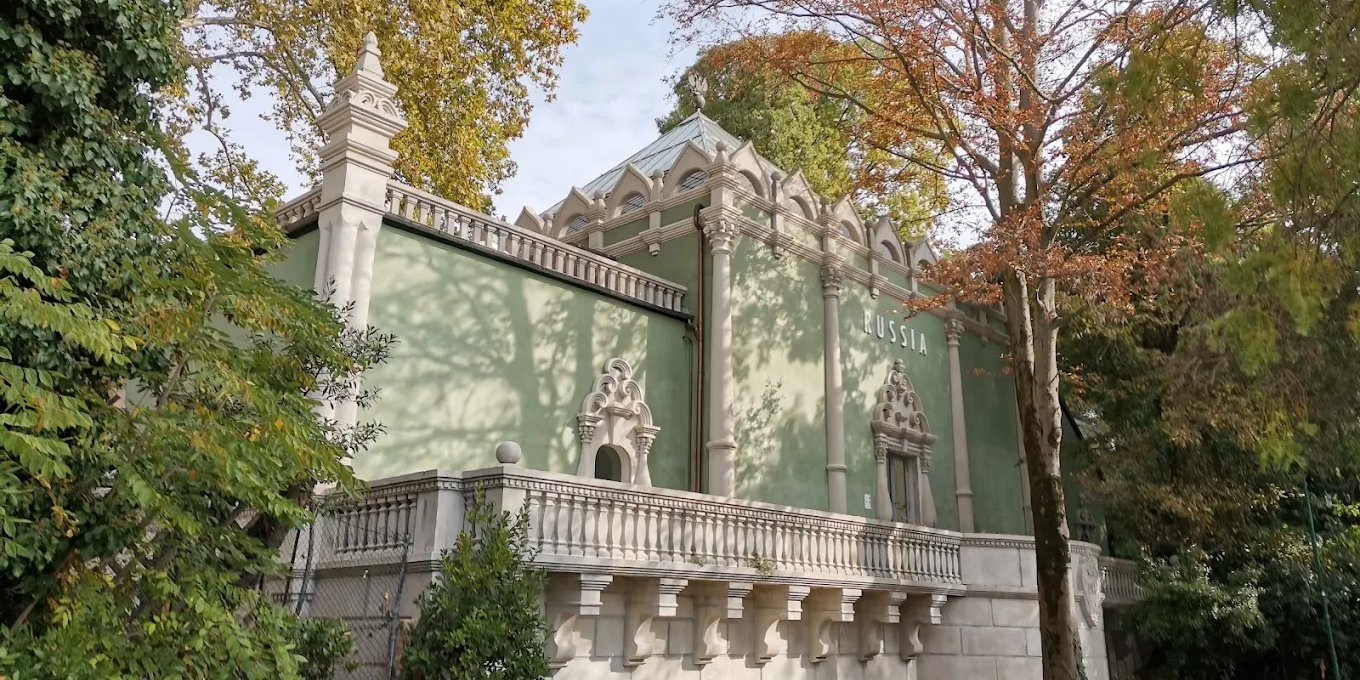
The Russian Pavilion at the Venice Biennale (Photo: André Filipe Correia da Fonseca/Google Maps)
The Russian pavilion at the 2026 Venice Biennale will be closed to the general public and accessible only during professional preview days, the art news outlet Artslooker reported on April 29.
The pavilion is scheduled to open exclusively from May 5 to May 8 for members of the press and the international art community to view the performance project The Tree Is Rooted In the Sky.
For the remainder of the exhibition—running from May 9 through Nov. 22—the building will remain closed to the public. Organizers plan to broadcast recorded performances or documentation on external screens in the windows without the physical presence of the artists.
The Italian publication Open reported that this restricted format was reached following negotiations between Venice Biennale leadership and Anastasia Karneeva, the commissioner of the Russian pavilion.
Leaked emails between Biennale President Pietrangelo Buttafuoco and Karneeva suggest that the Russian delegation has been lobbying for a full return to the official participant list since November 2025. Karneeva contacted Biennale Director Andrea Del Mercato to request letters of invitation to facilitate the visa process for the artists. He promised "full readiness and attention."
Similar requests were repeated in the following months, along with requests for support for other participants. The same emails also mentioned a desire to officially return to the list of participating countries—Karneeva asked Del Mercato to restore the Russian pavilion on the website and map, where it had been listed as Bolivia.
In January 2026, Karneeva sent the organizers a detailed pavilion proposal along with texts for the official catalog. The outlet believes that Biennale President Buttafuoco personally lobbied for Russia’s return to the exhibition.
A series of protests against the opening of the Russian pavilion is scheduled to take place in Venice from May 6 to 9.
Background of the dispute
The 2026 Venice Biennale marks the first time Russia has attempted to open a national pavilion since the full-scale invasion of Ukraine in 2022.
The decision has drawn formal protests from 22 European governments. Furthermore, 37 members of the European Parliament have urged the European Commission to suspend 2 million euros ($2.3 million) in funding for the Biennale, arguing that Russia’s participation undermines EU credibility.
Ukrainian President Volodymyr Zelenskyy recently signed a decree imposing sanctions on five Russian cultural figures associated with the pavilion, including Karneeva. Karneeva is the daughter of Nikolai Volobuev, a retired general and deputy director of the Russian state-owned defense conglomerate Rostec.
Kyiv has called on Italy not to issue visas to Russian participants in the Biennale.
In response to the mounting pressure, EU High Representative Kaja Kallas announced that the European Commission would cut funding to the event, calling Russia’s presence "morally wrong."
According to European Commission spokesperson Thomas Regnier, the Biennale has 30 days to respond and explain why the Russian pavilion was opened. If the response is not satisfactory, the European Commission intends to suspend or terminate the grant.
Latvian Minister of Culture Agnese Lāce stated that she would boycott the opening of the exhibition on May 9 if Russia participates. She initiated a joint statement calling for Russia’s exclusion from the Venice Biennale. It was signed by 25 countries.
The Finnish government also announced that its high-ranking officials will not attend this year’s exhibition if the organizers do allow the Russian pavilion to open.
The Biennale jury has since announced that it has excluded both Russia and Israel from consideration for major awards and stated that jurors will not visit their respective pavilions.
Will you support Ukraine’s free press?
Dear reader, as all news organizations, we must balance the pressures of delivering timely, accurate, and relevant stories with requirements to fund our business operations.
As a Ukrainian-based media, we also have another responsibility – to amplify Ukraine’s voice to the world during the crucial moment of its existence as a political nation.
It’s the support of our readers that lets us continue doing our job. We keep our essential reporting free because we believe in our ultimate purpose: an independent, democratic Ukraine.
If you’re willing to support Ukraine, consider subscribing to our Patreon starting from 5$ per month. We are immensely grateful.
Please help us continue fighting Russian propaganda.
Truth can be hard to tell from fiction these days. Every viewpoint has its audience of backers and supporters, no matter how absurd.
If conscious disinformation is reinforced by state propaganda apparatus and budget, its outcomes may become deadly.
There is no solution to this, other than independent, honest, and accurate reporting.
We remain committed to empowering the Ukrainian voice to push against the muck. If you’re willing to stand up for the truth – consider supporting us on Patreon starting from 5$ per month. Thank you very much.
Will you help tell Ukraine’s story to the world?
Twenty years ago, most people hadn’t even heard of Ukraine. Today, the country is on everyone’s lips and everyone’s headlines. War pushed us on the front page. But there are many other things we do that we are proud of – from music and culture to technology.
We need your help to tell the world Ukrainian story of resilience, joy, and survival. If you’re willing to back our effort, consider supporting us on Patreon starting from 5$ per month. We are immensely grateful.
Follow us on Twitter, Facebook and Google News
