

Military leaders, Sikorski and Schmidt map Ukraine’s wartime challenges at YES
 Read NV on Google
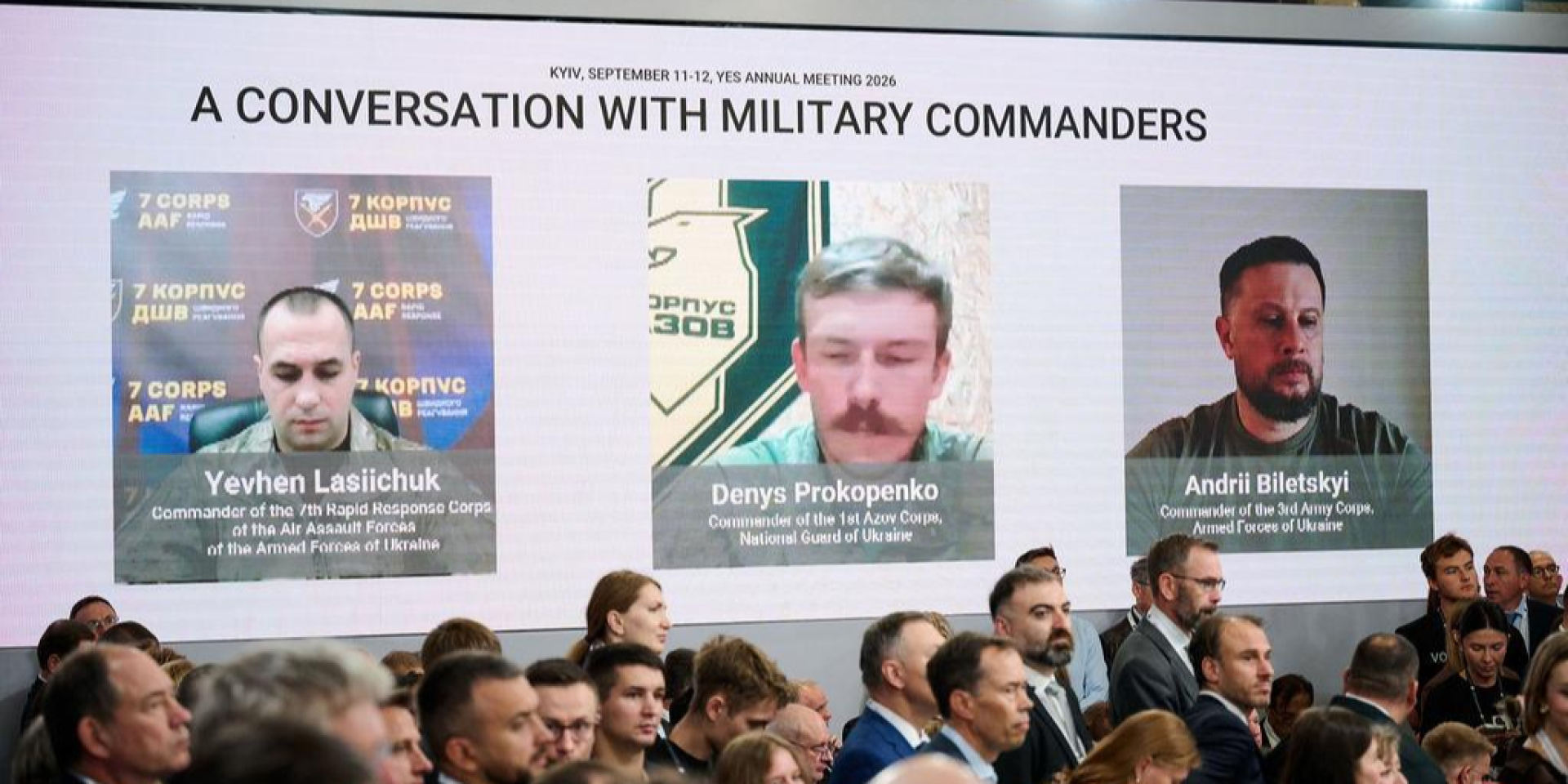
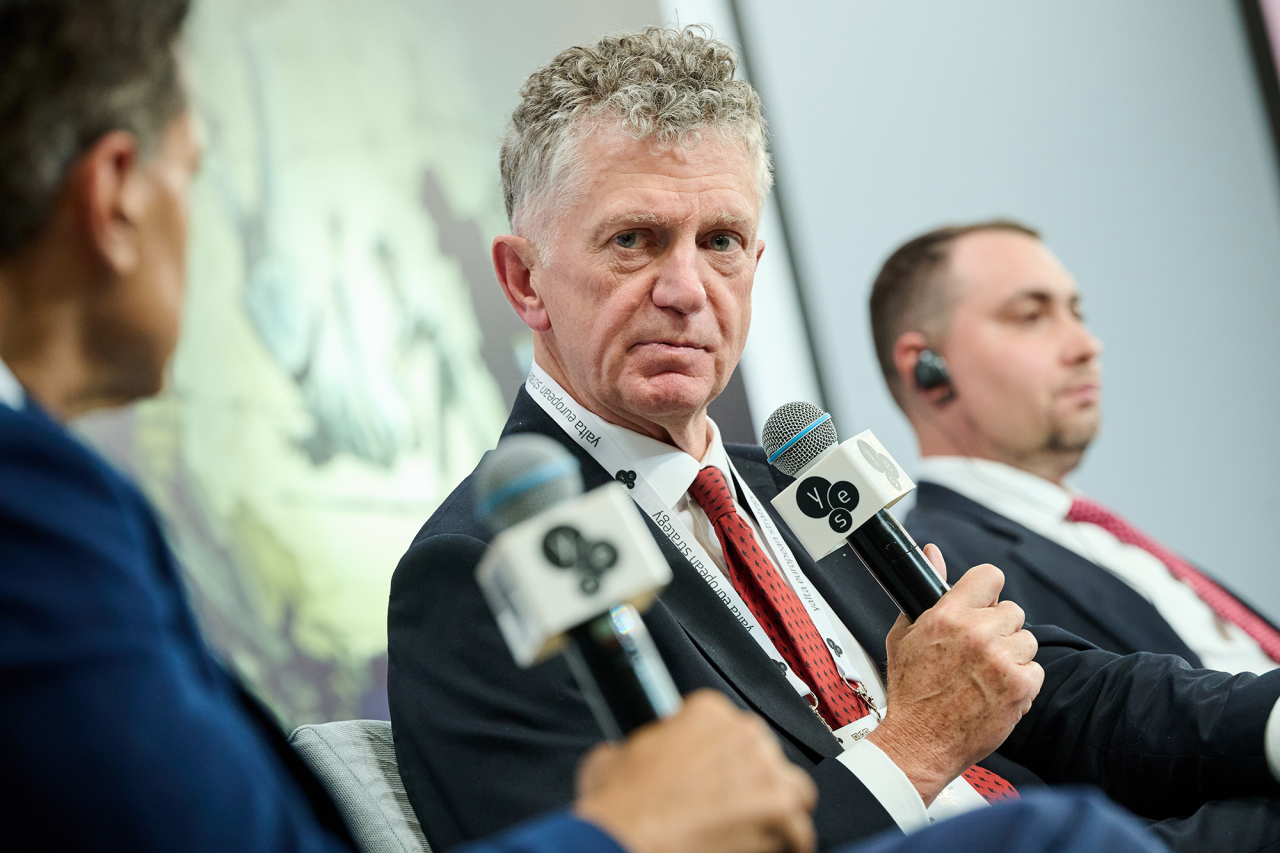
Panel discussion with commanders of major Ukrainian formations at the YES forum (Photo: Victor Pinchuk Foundation)
From a winter that could prove decisive for Ukraine to robot
warfare, NV, together with prominent YES participants, identified the forum’s
top speakers and offers brief summaries of their remarks.
“I think that in April, Russia will face an existential question: Why and
how should it continue the war at all?” Andrii Biletskyi, commander of the
Third Army Corps, said confidently from a large screen, speaking from a command
post in Donbas to a group of prominent attendees gathered in a hall in central
Kyiv.
Biletskyi’s remarks, along with many other speeches and views on war and
peace, were part of the latest Yalta European Strategy (YES) meeting, held in
Ukraine’s capital on Sept. 11–12.
The forum, traditionally organized by the Victor Pinchuk Foundation, brought
together about 700 politicians, diplomats, businesspeople, military personnel,
veterans, civic activists and experts from 28 countries.
The theme of YES 2026 was “Peace Through Strength NOW!”
After the forum, NV surveyed participants to determine which speeches had
made the strongest impression on them. The newsroom received a list of 24
speeches. Five — four individual speeches and one group appearance — received
the most votes. NV summarizes them below.
Five military officers
Participants in NV’s survey most often cited not one speaker but five senior
Ukrainian military officers, most of whom joined the panel discussion online
directly from combat zones.
One of them, Andrii Biletskyi, commander of the Third Army Corps, told YES
participants in Kyiv from northern Donetsk Oblast that the winter would be
difficult and that “victory or defeat here will depend on whether we close
Ukraine’s skies this winter.”
“This task has two components: protecting the skies from the missile threat,
from ballistic missiles, and protecting the skies from jet-powered Shaheds and
jet-powered drones of the ‘Shahed parcel’ type,” Biletskyi said. “If we get
through these challenges with dignity and effectively, I think that in April,
Russia will face an existential question: Why and how should it continue the
war at all, because it will not achieve any of its strategic objectives.”
Denys Prokopenko, commander of the National Guard’s 1st Azov Corps, stressed
that confronting Russia is a major challenge for all civilized Western nations.
“This isn’t a war between two armies; this is war and terror against
civilians, the daily destruction and devastation of our energy infrastructure,
the torture to death of our prisoners of war, and the forced mobilization of
Ukrainians in temporarily occupied territories,” the corps commander said.
“And, unfortunately, all of this awaits European countries if Ukraine stops
resisting.”
Prokopenko stressed that Ukraine is giving Europe, the United States and the
entire civilized world the most valuable resource before a large-scale war
begins — time.
Yevhen Lasiichuk, commander of the Armed Forces of Ukraine’s 7th Rapid Response
Corps of the Air Assault Forces, said Ukraine is now on the verge of the next
technological step: partially replacing people with robots. That would mean
fewer people on the line of contact and fewer personnel losses.
“But to implement this plan, our partners’ support in scaling up successful
practices and technologies is crucial,” Lasiichuk said.
He stressed that Ukraine is paying a very high price for its experience,
“which tomorrow could save our partners’ lives.”
Oleh Apostol, commander of the Air Assault Forces, told the YES audience
that Russian aggression poses a long-term threat beyond Ukraine because the
Kremlin has shown no intention of stopping even if it hypothetically achieves
its goals in Ukraine.
“You can see there are signs that he is considering a strike on the Baltic
states,” he said. “All right, would he stop at the Baltic states? No, he
wouldn’t.”
Another military speaker, Ihor Obolenskyi, commander of the National Guard’s
2nd Khartiia Corps, explained in straightforward terms the critical role
Ukraine now plays in NATO’s security.
“It isn’t the war that is deterring Russia from attacking the West, but
Ukraine and the Ukrainian people,” he stressed. “And 12 years passed between
‘let’s not admit Ukraine to NATO’ and ‘thank God Ukraine exists.’”
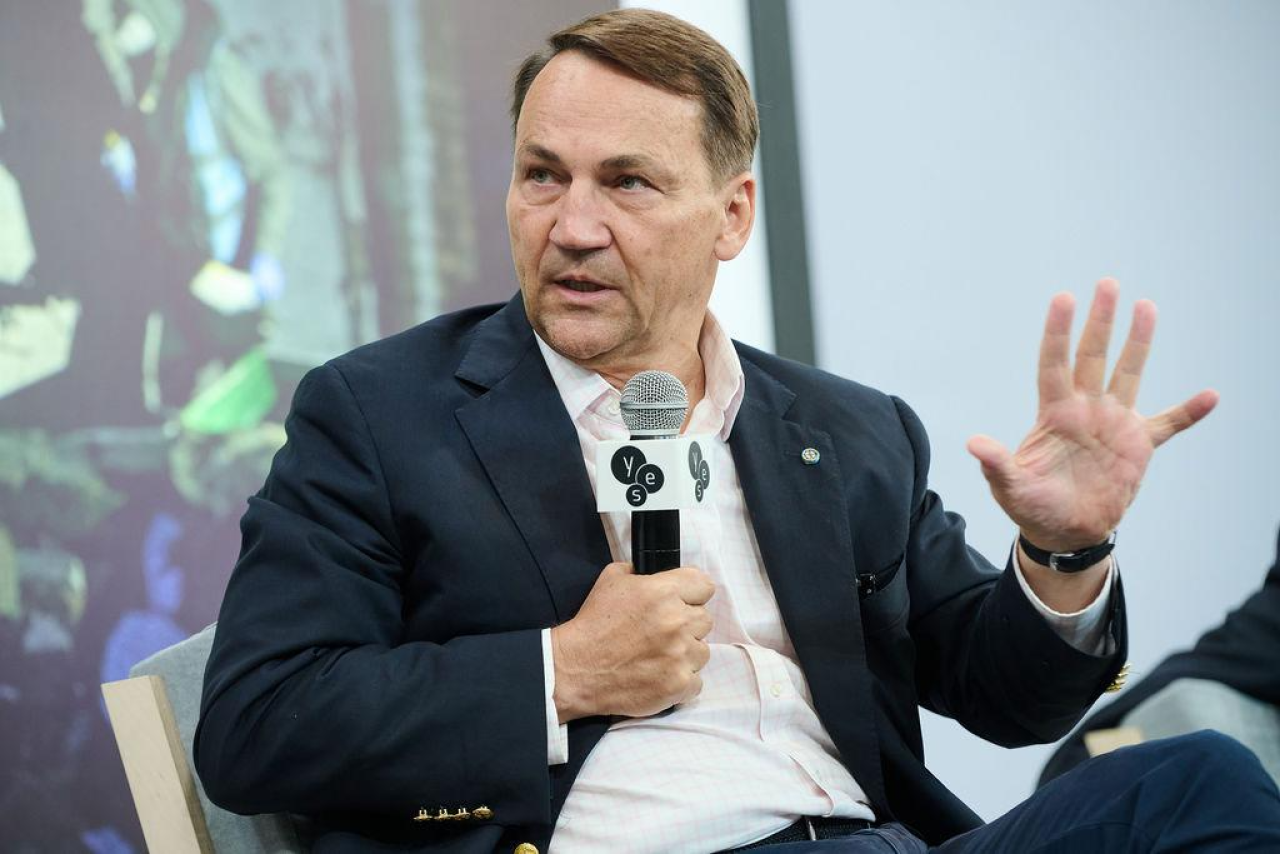
Radosław Sikorski, Poland’s foreign minister
Poland’s top diplomat and deputy prime minister, Radosław Sikorski, spoke
twice at the forum. He first took part in a discussion on Europe’s view of how
the war could end and later addressed whether the West could innovate quickly
enough.
Sikorski believes Putin began the full-scale war with extraordinarily
audacious ambitions and genuinely thought he could restore the Soviet Union and
turn Russia into a superpower — one of three powers ruling the world.
“I think he understands that this plan is unattainable,” Poland’s foreign
minister said. “His fallback plan was to regain control over at least Ukraine’s
foreign policy. But that failed too. And now it seems to me that he wants to
get out of this war with at least some kind of victory. That is why he keeps
setting deadlines for capturing Donbas.”
Sikorski believes the war could end in one of two ways: through negotiations
or by gradually petering out when Putin runs out of resources. To bring about
the latter, he said, Ukraine should focus on striking Russian oil refineries.
Sikorski told participants that if more than half of Russia’s refineries
were damaged badly enough that they could not be quickly repaired, the Kremlin
would be physically unable to continue the war.
“We have to support Ukraine when it comes to gas and electricity,” the
diplomat added. “Europe will manage. We have done a much better job
diversifying our energy sources. Scandinavia uses renewable energy, France uses
nuclear power. In Poland, gas storage facilities are already 80% full. Our
households consume about one-third of all gas — we can meet those needs with
our own production even if supplies stop completely. Putin may partially
restrict our fertilizer production, but he won’t be able to stop us.”
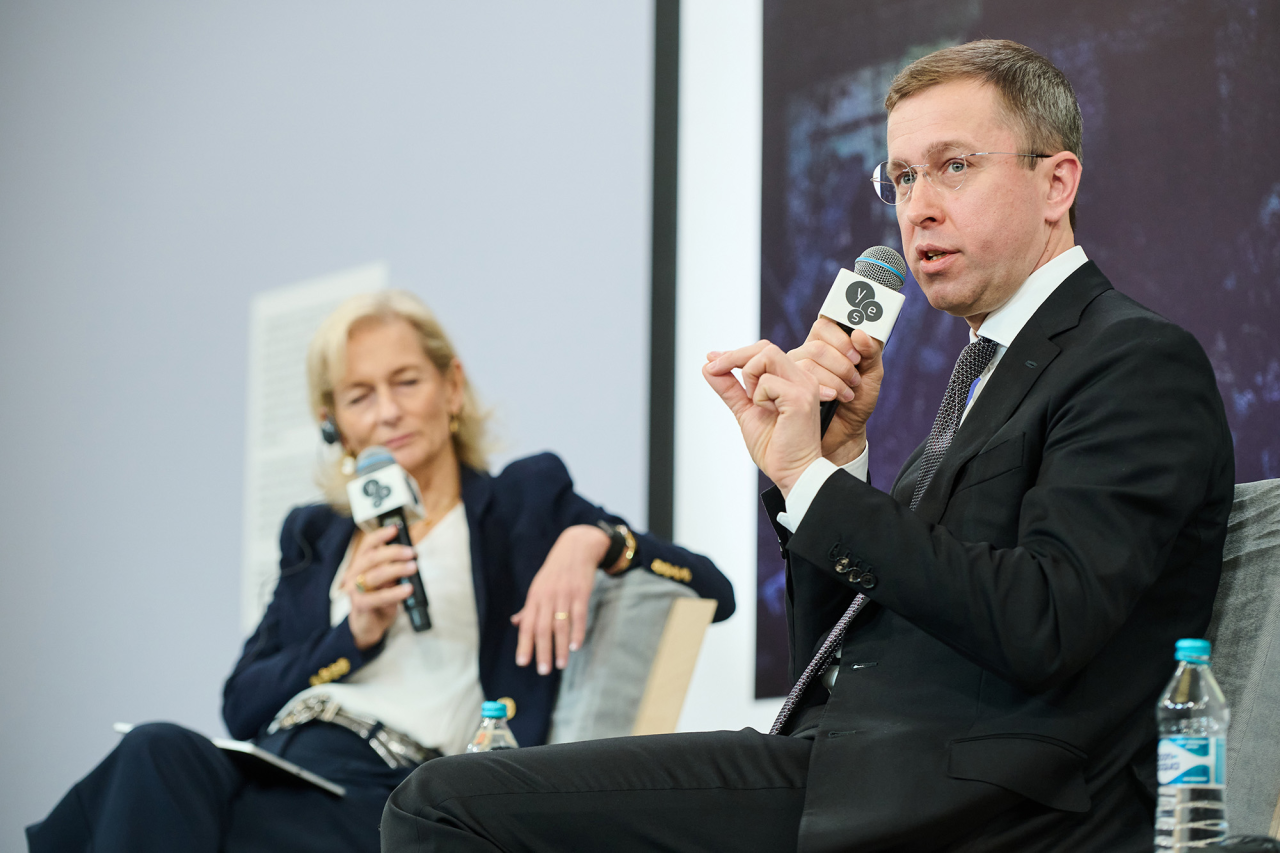
Serhiy Koretskyi, prime minister of Ukraine
Serhiy Koretskyi addressed the forum for the first time as head of
government, and many participants awaited his speech with keen interest.
Koretskyi said that despite the difficult period, Ukraine, with support from
its partners, has enough strength and determination to make it through the
winter while carrying out tactical tasks and continuing the country’s strategic
development.
“We have enough optimism, enough strength, and enough determination among
the team and everyone else to overcome these difficulties,” the prime minister
said. “The fact that this is a difficult period is undeniable. I am counting on
support and joint work so that we can make it through the winter with dignity,
continue tackling tactical tasks and strategically develop the country.”
The head of government also spoke about the need to decentralize energy and
logistics, strengthen cooperation with businesses and neighboring countries,
and introduce flexible border-crossing rules to keep transportation moving
without interruption.
“So we have a clear plan with retailers and logistics companies. We know how
to implement it. We have a plan for putting certain logistics procedures in
place with our neighboring countries. We are discussing a flexible
border-crossing system — fast and uninterrupted, a kind of fast track for
freight movements in both directions,” he added.
Koretskyi also said the government is considering separate funding for
war-risk insurance for businesses.
“We believe the traditional form [of insurance] does not work,” he
explained. “We have a clear plan with the economy minister and finance minister
to create a separate budget line to which the state would allocate a certain
amount of money.”
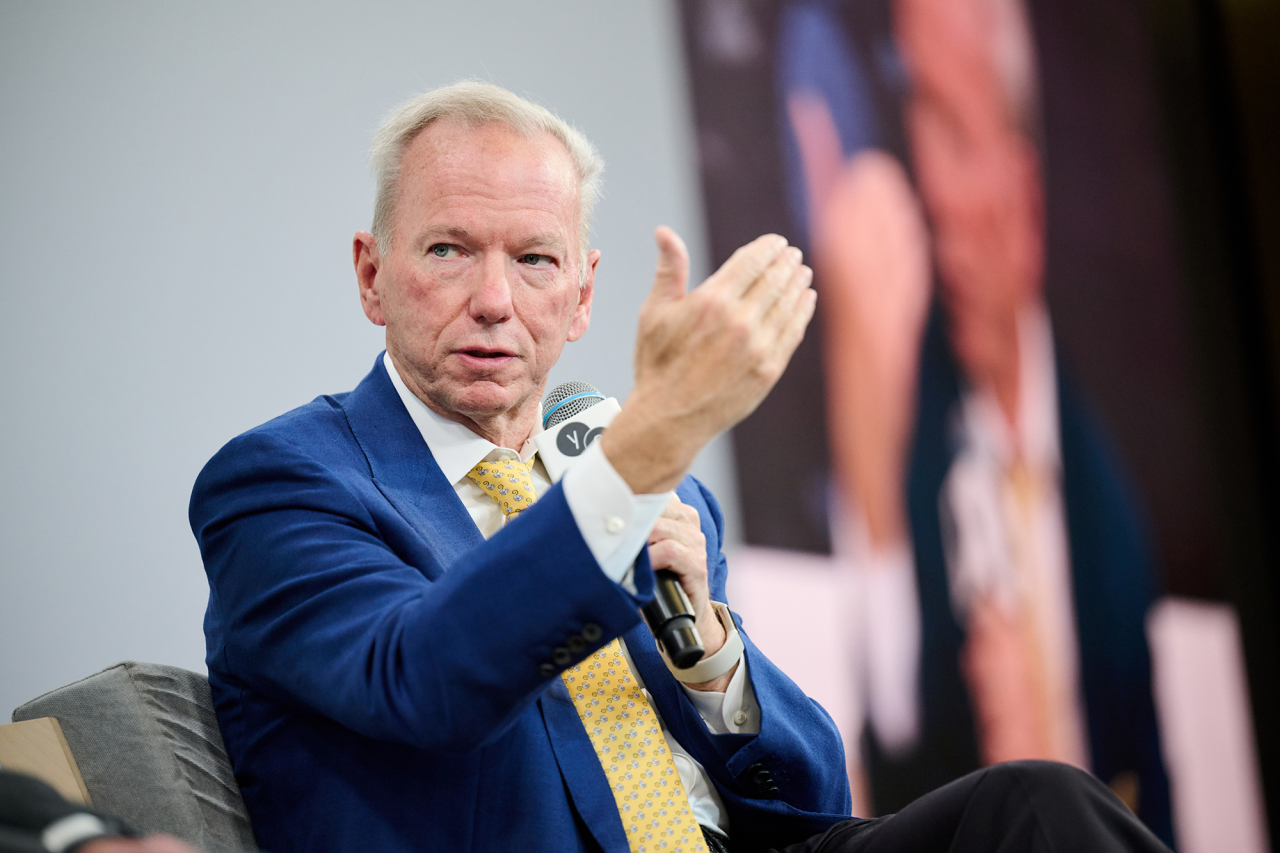
Eric Schmidt, former Google CEO
Eric Schmidt spoke during a discussion about whether the West could innovate
quickly enough in the face of future wars.
The former Google CEO said virtually all traditional assumptions about
warfare and certain types of military equipment are probably already outdated.
“Ships are big targets. Tanks are a terrible idea,” he said. “Drones may
look like toys, but especially when used in swarms, they are extremely
powerful.”
Schmidt also argued that after four and a half years of war, Ukraine knows
what it is doing. Moreover, he said, the country is organized to win the war.
It lacks only two things — money and scale.
“This is a big war,” Schmidt concluded. “You need a lot of everything. The
right solution is to bring in contract manufacturers in the West to help
provide Ukraine with the defensive and offensive systems it needs.”
Jonathan Powell, U.K. prime minister’s national security adviser
Many forum participants also remembered the remarks by Jonathan Powell,
national security adviser to the British prime minister.
Powell reflected on how the full-scale war might end. He believes that at
some point, when everyone least expects it, Putin will agree to negotiations.
“This is the only way the war will end,” Powell said. “Putin will not take
Ukraine. He will not subjugate Kyiv. Negotiations will happen. And he will have
to take part in them. The key is to make him take those negotiations seriously.
And I think our strategy is beginning to work.”
Powell also said dialogue should be maintained with these “terrorists” —
meaning Russians — so contact is not lost. But that does not mean making
concessions to them.
Powell also said Ukraine and its partners do not need to play Russia’s game
to succeed because Putin already has plenty of problems.
“He is escalating and trying to scare us precisely because he understands
that his strategy is not working,” the adviser stressed. “He is failing to
seize territory. He is failing to break the Ukrainians’ morale.”
Participants in the survey to identify the top speakers included:
- Hlib Vyshlinskyi, executive director of the Center for Economic
Strategy
- Oleksiy Haran, political scientist and professor in the Department of
Political Science at the National University of Kyiv-Mohyla Academy
- Maria Hryhorovych, COO and creative director of GSC Game World
- Nataliya Gumenyuk, journalist and documentary filmmaker
- Matthew Day, journalist and head of online news at TVP World
- Agnès Callamard, French human rights advocate and secretary-general
of Amnesty International
- Kersti Kaljulaid, former president of Estonia (2016–2021)
- Dmytro Koshovyi, editor-in-chief of the Interfax-Ukraine news agency
- Roksolana Pidlasa, Servant of the People lawmaker and chair of the
Verkhovna Rada Budget Committee
- Kristi Raik, director of the Estonian International Centre for
Defence and Security (ICDS)
- Serhiy Sydorenko, editor-in-chief of European Pravda
- George Scutaru, former member of Romania’s Chamber of Deputies and
co-founder and CEO of the New Strategy Center
- Yehor Firsov, former Verkhovna Rada lawmaker and officer with the
Third Army Corps’ Kraken 1654 Unmanned Systems Regiment
- Yehor Cherniev, Servant of the People lawmaker and deputy chair of the Verkhovna Rada Committee on National Security, Defense and Intelligence
- Hanna Shelest, director of security programs at the Foreign Policy
Council “Ukrainian Prism.”
The military war may be swinging in our favor, but the information war continues.
Just as an army needs soldiers, so does a free society need its journalists to ensure that people have access to honest, trustworthy voices to understand the world around them.
For the past five years, The New Voice of Ukraine has been working tirelessly to push back against Russian narratives and defend democracy. But we cannot do it alone.
Please consider supporting us on Patreon for just $5 a month – your donation does directly to supporting journalists and ensuring that this front of the infowar says solid and defended.
Thank you.
Follow us on Twitter, Facebook and Google News
