


‘I never said it was either me or Syrskyi. But I cannot stay silent.’
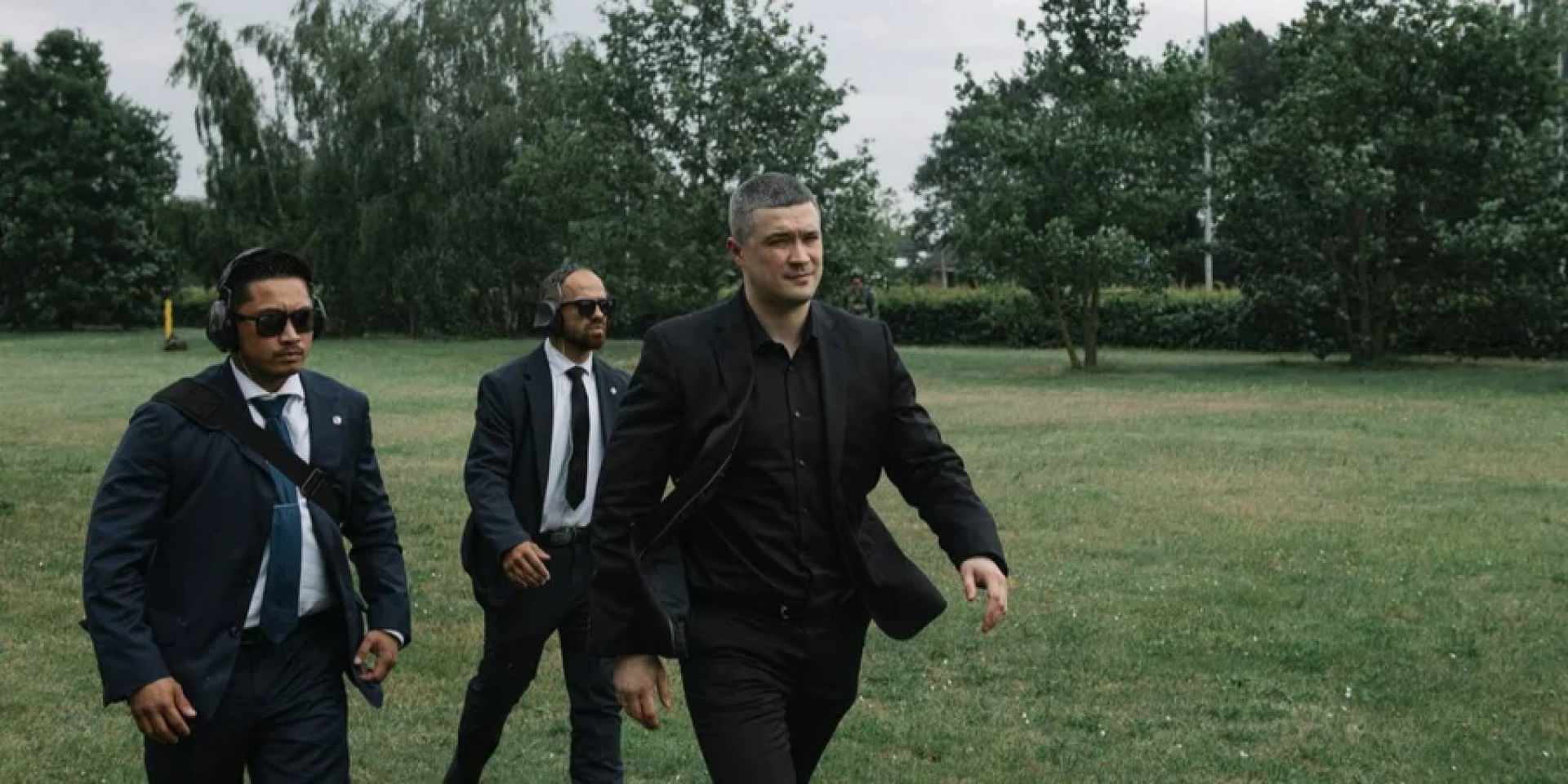
Mykhailo Fedorov: “I think the time has come to talk to Ukrainians like adults. There are certain problems that need to be resolved. We cannot remain silent about them.” (Photo: FEDOROV via Telegram)
I want to briefly discuss my record as defense minister.
This column was prepared from remarks by Mykhailo Fedorov and a Q&A
session at a briefing.
My work in defense actually began earlier, when Russia launched its
full-scale invasion in 2022 — the Starlink story with Elon Musk, the Army of
Drones...
I joined the president’s government back in 2019. And I am probably the last
minister from that first government to be dismissed...
I did not build a political career, start my own companies or go into
business. There were no corruption scandals or schemes. We built a digital
state, and judging by public opinion polls, it is probably the biggest reform
recognized by Ukrainian citizens.
We launched Diia, Mriia and Diia.City. We built out telecommunications and
made it through difficult winters. We faced a great many problems and
cyberattacks, but we built a digital state.
Today, I want to discuss the results of our work not only during my six
months as defense minister, but since 2022 — and the problems that remain.
I think the time has come to talk to Ukrainians like adults. Certain
problems need to be resolved. We cannot remain silent about them.
What we accomplished
It all began in 2022, when we made an unprecedented move that the government
supported at the time: We raised permitted profit margins for drone
companies and opened the market, allowing margins of up to 25%.
Those are among the best conditions anywhere in the world for building a
business. We analyzed every country before making the change.
We then launched United24, a
fundraising platform, and its first Army of Drones campaign. We began
raising money and used it to invest in drones and make the first purchases. At
the time, the Defense Ministry was not buying drones.
Then came the funding and development of naval drones. Fundraising also
allowed us to purchase the first naval drones on something approaching an
industrial scale. They began striking Russian ships.
Today, there are many companies, an established market and government
contracts. But we started it together as a startup.
Then came procurement under the Deep Strike program. I remember HUR’s
first deep-strike drone reaching and hitting its first target.
Today, these strikes are our long-range sanctions, which the entire world is
discussing. They are now a card in our hand that cannot be hidden.
Another important part of our technological story was the development of
the Delta system. To be honest, we had to protect it from every commander
in chief I dealt with.
Today, Delta is something the entire world needs: network-centric warfare
built around the best digital system for conducting war, developed by military
personnel in our country.
We introduced strike-drone companies in the Armed Forces. They later
grew into the Unmanned Systems Forces, but we launched the first companies
without state budget funding.
We raised money from businesses and bought pickup trucks and the first
drones. We believed deeply in the project because we understood that it
represented the future.
Then came the e-points system. It is a game changer for the entire
world.
The system allows our units to use electronic points awarded for destroying
enemy targets, with video confirmation, to buy drones directly from the
battlefield. It is a kind of “Amazon for war.”
It helps us win every innovation cycle because products are updated every
two or three months. It provides fast money and fast points that help the
military obtain modern technology.
Syrskyi is willing to attend meetings and plot behind the scenes
A decree establishing the Unmanned Systems Forces was then signed. I
remember it well. The president and I were alone in his office, and we had been
discussing the issue for a long time.
The decree was signed quickly. Today, everyone knows about Magyar’s
achievements, and we are all proud of the system we managed to build.
The next step was the launch of the Drone Line, which is now
responsible for killing every third or fourth Russian soldier on the
battlefield.
Using the e-points system, we selected the best units because we now had an
objective monitoring system. We began providing those units with direct
funding, allowing them to grow.
Our logic was that when there is no time to build the system — although the
system does need to be built — the fastest thing we can do is support the
strongest units.
Lazar, Alpha, Magyar, Achilles and K-2 — all the top units you know — began
receiving billions in funding.
Do you see how all of this is connected, financed and put into practice?
Then came the funding and launch of the explosives market, another
important stage in our country’s development.
We also recently provided nearly 1 billion in grants to the private sector,
startups and innovative manufacturers.
Our next decision — an aggressive one — was to open the interceptor-drone
market and test the drones under combat conditions in several oblasts.
Private companies were allowed to enter an oblast, integrate with the air
defense system, test interceptors against Shahed drones in real time and
receive $10,000–$20,000 as an incentive to continue developing them.
It was a completely unconventional decision. Everyone opposed it, but at a
meeting of the Supreme Commander-in-Chief’s Staff, the president said: “Into
combat. Let’s go.”
Today, interceptor drones shoot down 70%–90% of Shaheds.
With unmanned ground vehicles, or UGVs, we encountered systemic
sabotage.
Last year, we managed to contract for 12,000 UGVs despite considerable
opposition. But once again, a political decision was made: Move forward and
sign the contracts.
This year, 50,000 UGVs will be purchased. That is a record number. Everything
that can be bought is being bought.
Then came the launch of drone-assault units. Please do not confuse
them with assault units.
Under modern conditions, technology must become the central element around
which an organization is built.
A decision was also made to provide several units with additional funding so
they would have the necessary resources and money. The goal was to demonstrate
how drones could take out everything ahead of them, allowing infantry to move
in afterward, retake territory and suffer minimal losses.
CODE 9.2 and Khartiia then retook Kupyansk. They were able to invest the
money they received in additional capabilities.
This is how a modern army should fight: Drones go first, then people. We
protect the lives of our service members.
Operation Ashan was aimed at destroying equipment. It was built
around the Lazar and Nemesis groups.
We massed large numbers of copters and, over several nights, sent thousands
of drones 50 kilometers deep. More than 700 pieces of equipment were destroyed.
That happened in May last year. The result? From May through October, the
enemy did not launch a single mechanized assault.
This year, we carried out Ashan 2 and destroyed 250 enemy artillery systems
over two nights because Russian artillery is killing our people.
Another structurally important decision was cutting Russian forces off
from Starlink.
We spoke with Elon Musk after the first Starlink-equipped Shahed flew over
central Kyiv and we realized it would become a serious problem.
Operator-controlled Shaheds that electronic warfare cannot jam could change
their flight paths and destroy our entire air defense network — Patriots, F-16s
and much more.
I thought there was a 1% chance we could get it done. But Elon said: “Let’s
just talk by video.”
It was our first video call. Until then, we had always communicated by text.
We spoke, and he said: “OK, I’ll do it... There is just one thing: I am
changing the terms for Starlink buyers. You will now have to register them.”
That looked like a disaster.
But because we had built a digital state, large numbers of Starlink
terminals in Ukraine were registered through administrative service centers and
Diia. Even SpaceX was surprised that we could implement projects like this in a
matter of days.
Another important step was creating a small-scale air defense system
after our team arrived at the Defense Ministry.
Our idea was to build a system capable of intercepting at least 95% of all
Shaheds and cruise missiles through better organization and new technology.
We encountered many obstacles that prevented us from fully implementing it.
What we did not fully accomplish
Russia has always operated at operational depth. That is how Russian
doctrine is built; Russia essentially created the concept.
Our forces are only now transitioning to a corps-based system. Previously,
everything operated mainly at the tactical level.
You can see how medium-range strikes are already changing that.
Second, the corps system has not become fully operational.
We have successful corps that advance every month or at least do not lose
territory. We also have corps whose commanders are constantly replaced.
Some corps have become schools in their own right, with their own
philosophies. With others, we do not even know how many brigades they contain
or what is happening inside them.
That brings us to the third problem: the fragmentation of brigades and
corps.
Some brigades cannot even compile a count of their own battalions. A
battalion is pulled from one brigade and thrown into another.
It is impossible to build an effective command system under those
conditions.
No one is accountable for anything. That is the old story.
The people at the front, who were simply carrying out their missions, always
get blamed. Responsibility is always pushed down the chain.
It is a culture that has developed over the years — no one is held
accountable.
Commanders are constantly replaced.
A brigade commander arrives, works for a month and is removed. Another
arrives and is removed.
This is closely connected to the previous problem — no one is accountable
for anything. With an organization like this, it is impossible to build,
forecast or plan.
Supplies do not move through the corps. In reality, the supply
problem is fundamental.
For example, over the past five months, we bought more drones than during
all of last year.
But most units did not feel the difference because resources are still
handed out manually. Loyal units receive them; disloyal units do not.
It took us four months to approve a simple project — a basic allocation of
drones to brigades.
If we are buying large numbers of drones, then every brigade and corps
should receive a set allocation so they can plan their next operations on the
battlefield.
The next problem is the isolation and vilification of those who are
making progress.
You are succeeding? Great. Off to the sidelines.
Drapatyi? A third reprimand, and goodbye. I am sorry, Drapatyi — I think you
will receive a fourth reprimand after this speech.
We can no longer avoid talking about this.
When someone succeeds — Lazar in the Air Force, for example — the response
is: Fine, we will spend two months refusing to approve a commander for you. We
will deny you an allocation.
Let’s send you to training so you can deal with bureaucracy instead of doing
your job.
No systemic project can be carried through because you constantly
face the same questions: “Why? How? Should we try to force it through?”
Human capital is being wasted without analysis.
We did an enormous amount of work. For the first time, we built a real-time
system for analyzing the battlefield and losses. We began receiving daily
reports on losses.
But decisions about whom to support, whom not to support, whom to reinforce
and whom not to reinforce are not based on data. They are based on loyalty.
Initiatives are blocked, followed by bureaucratic warfare.
During six months at the Defense Ministry, we were unable to establish
centers of expertise or change the organizational structure because the General
Staff would not sign off on it.
Either the name was wrong or there was some other excuse... The message was:
“We do not need to bring in new people capable of generating ideas.”
We kept hacking around the system with unconventional solutions, and we
continue to do so. But that does not work at the scale of a serious
institution.
During our entire time at the Defense Ministry, we managed to transfer
perhaps three to five people.
Just imagine that: A country at war that generates solutions cannot transfer
people into the Defense Ministry because the process is being blocked.
Then there are the constant lies — that I was behind the Skelia case,
that I launched a media campaign...
This is a culture that must simply be rooted out. Otherwise, we will not be
able to defeat an enemy whose system suffers from the same problems.
What solutions did we propose?
Sweeping personnel changes — replacing both the commander in chief and the
chief of the General Staff.
I said today that we need to talk like adults.
We have no other choice if we want to defeat the enemy asymmetrically and
with minimal losses, in a system where strong leaders and commanders can grow
instead of being suppressed, written off or reprimanded.
A modern organization built around technology requires leadership in
command. It needs a completely different management model.
Strong corps commanders must also be appointed.
We have several corps that everyone knows — the Third Corps, Khartiia, the
8th Air Assault Corps and many others that are producing results.
But there are also many corps with as many as 13 brigades that cannot
establish an effective command structure, and we do not know who is responsible
for what.
Third are the drone-assault forces.
This requires a complete change in how we use infantry.
A decree establishing operational response forces has now been signed. I
hope they will become the foundation of the drone-assault units, with
technology doing the fighting so that we lose drones rather than people.
Only then should the infantry move in.
We must fight for every person. We simply cannot mobilize as many people as
the Russians do.
We must rely on asymmetry. Everything we do well involves technology and
asymmetry.
We also need to realign the front line and implement a doctrine.
I will not go into detail here. The point is that we must avoid losing
people wherever losses can be avoided.
We need to base our positions on the terrain and the battlefield situation
and build defensive lines that wear down the enemy as much as possible and stop
its advance.
We must develop new leaders capable of growing, running staffs and
commanding units.
A clash of two egos? On the conflict with Syrskyi
When the president said he did not plan to replace Syrskyi, that was his
decision as supreme commander in chief.
I fully accepted the decision and said: “Then I will learn to work with him,
because the Ukrainian people are the ones we serve.”
But we found that every initiative we proposed was being blocked, and
Syrskyi was unwilling to discuss the problems personally, openly and face to
face.
He is willing to attend meetings in person, plot behind the scenes and
imagine that someone commissioned a media campaign involving Skelia — as though
the real problem were not what was actually happening.
This ultimately amounted to an ultimatum.
Instead of figuring out how to defeat Russia asymmetrically — which is the
commander in chief’s job — he figured out how to divide the country, which is
where we now find ourselves.
This is a major problem. I am not the type to go around complaining.
I never said it was either me or Syrskyi.
I said: “Then we will defeat Russia with this commander in chief.”
The truth is that Syrskyi saved our country in 2022. He led the Kyiv
operation, the Kharkiv operation, the Kherson operation and many others.
We cannot underestimate a commander like that.
But the war has changed completely.
The command system has changed. We must change as well. We cannot keep
relying on what worked before.
I do not think this is a clash of egos between Syrskyi and me. There are
probably other reasons.
But as I have said, many documents were never signed. I was told: “Do not
touch it.”
I put up with that and was prepared to continue working calmly until the
commander in chief issued an ultimatum.
Yesterday, I had a normal conversation with the president.
He offered me an advisory position or suggested finding another way for me
to remain on the team.
I declined the advisory role.
I never sought to become or remain a minister, and I never went looking for
a position. But I can see that the truth must be told.
You cannot allow yourself to become hostage to certain obligations.
After seven years, no one can say that I played politics, engaged in
corruption or built schemes.
For seven years, I worked alongside the president on reforms and went
wherever I was sent, to the most difficult areas of the country’s
transformation.
But today, this is not about me. It is about all of us.
We either close our eyes and say, “OK, let everything continue as before,”
or we say, “Stop. The Ukrainian people know how to fight.”
My job is to show what we accomplished and what risks lie ahead.
I have worked on this around the clock for four years.
I do not want someday to look my children in the eye, knowing that I failed
to speak about what was really happening.
There are many people in the military who could accomplish far more if they
were given freedom and their leadership was supported.
They would not run from the battlefield.
All the claims that Syrskyi can hold the front because he is dictatorial and
authoritarian are false.
Ukrainians stopped the Russians because they made the decision to do so —
they went out and stopped them.
Ukrainians do not need someone above them with a club, driving them into
front-line positions under drone fire.
Ukrainians make their own decisions.
The defense minister is the president’s appointment.
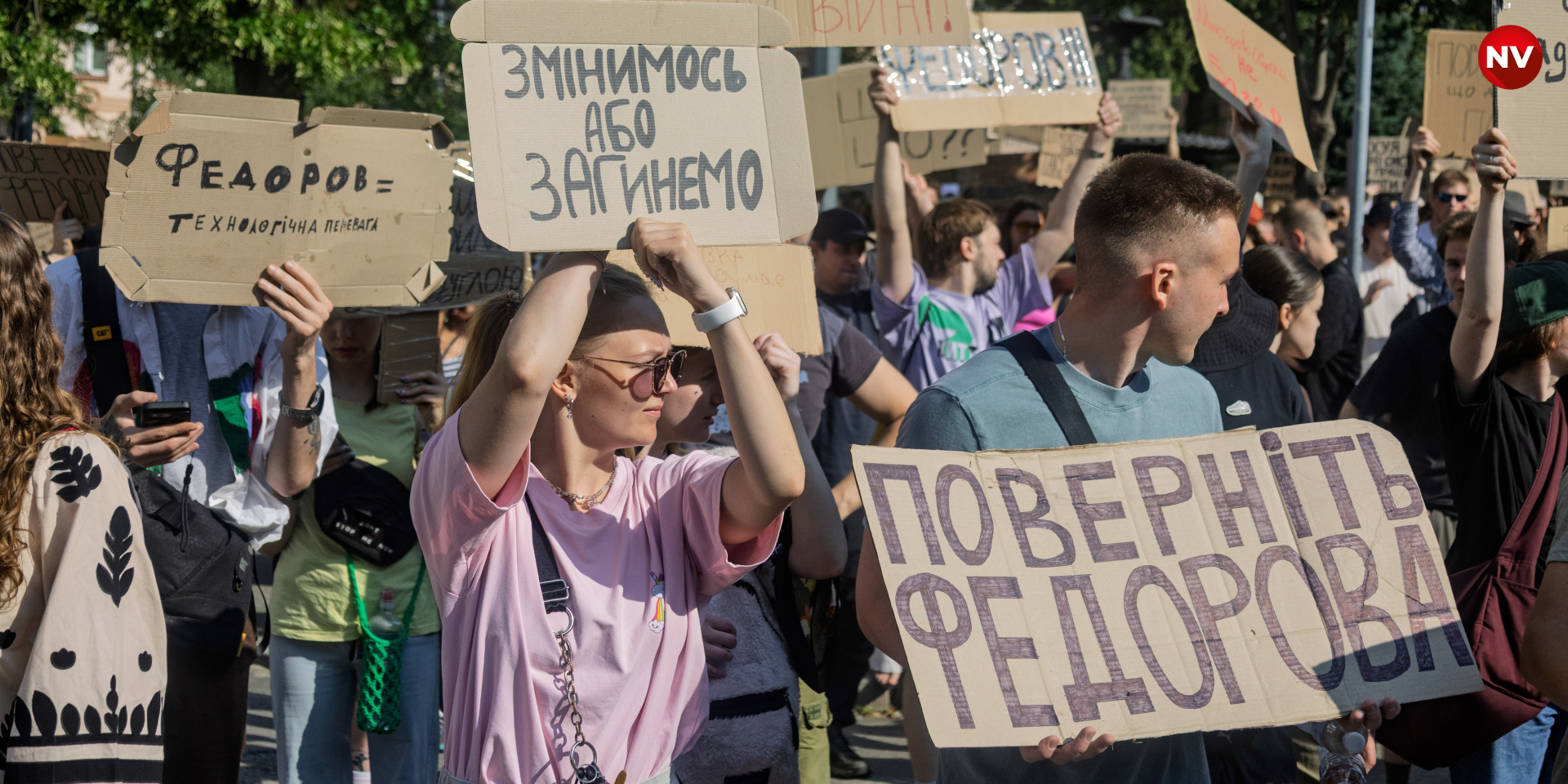
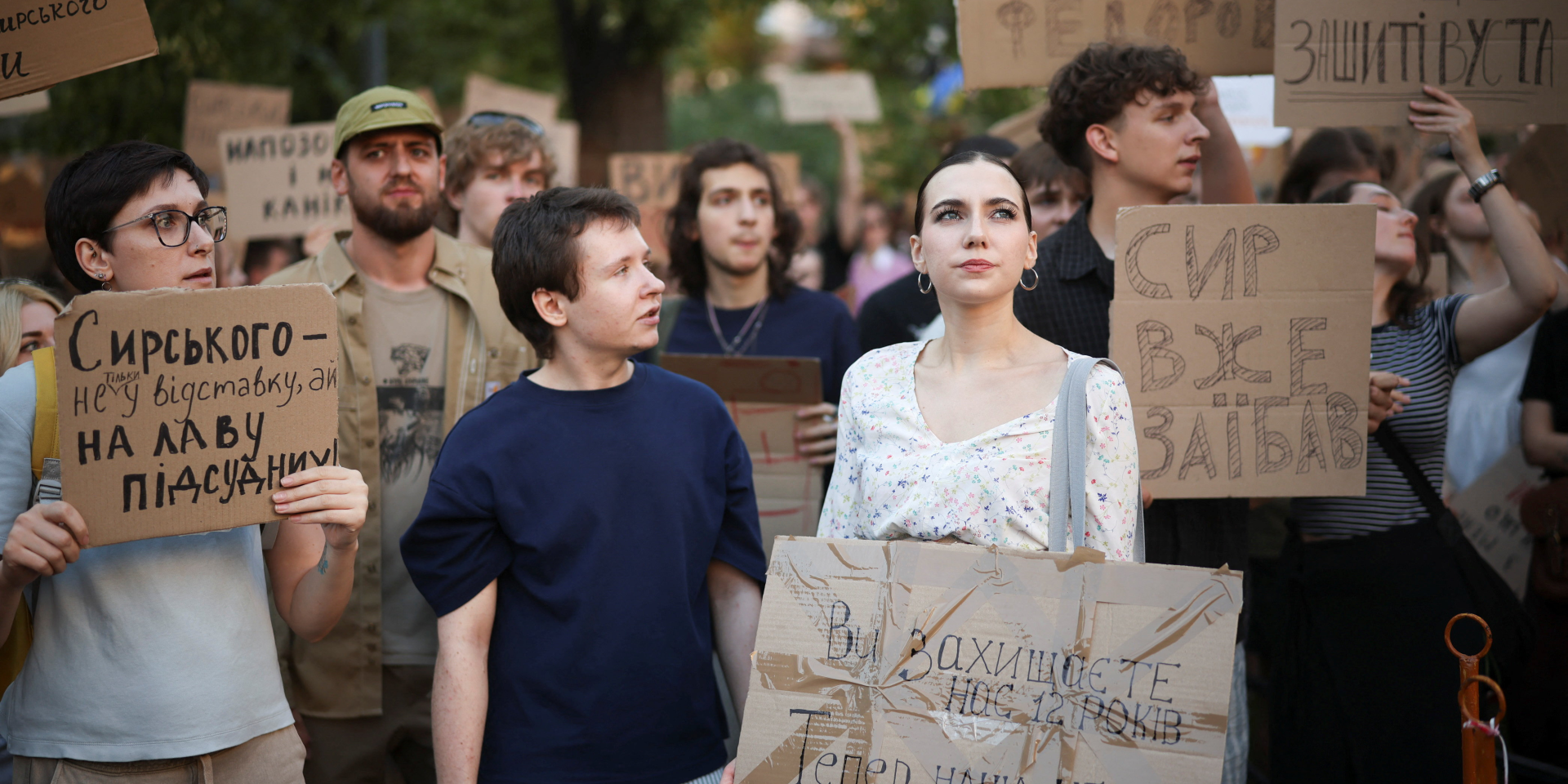
Today, the Ukrainian people did not take to the streets for one particular
minister named Fedorov. They took to the streets for themselves.
Ukraine had seized the initiative on the battlefield and in the skies. So
why is that trajectory now being broken, and why are we veering away from it?
That risk exists. That is why the Ukrainian people took to the streets.
This is not about me at all. Today, it is about the root of the problem.
I do not need the defense minister’s job simply for the sake of being
defense minister.
I need the position to win the war.
Under this arrangement with Syrskyi, I personally do not know how the war
can be won.
The military war may be swinging in our favor, but the information war continues.
Just as an army needs soldiers, so does a free society need its journalists to ensure that people have access to honest, trustworthy voices to understand the world around them.
For the past five years, The New Voice of Ukraine has been working tirelessly to push back against Russian narratives and defend democracy. But we cannot do it alone.
Please consider supporting us on Patreon for just $5 a month – your donation does directly to supporting journalists and ensuring that this front of the infowar says solid and defended.
Thank you.
Follow us on Twitter, Facebook and Google News
