

Putin’s mobilization gamble could expand army while destabilizing his regime — NV analysis
 Read NV on Google
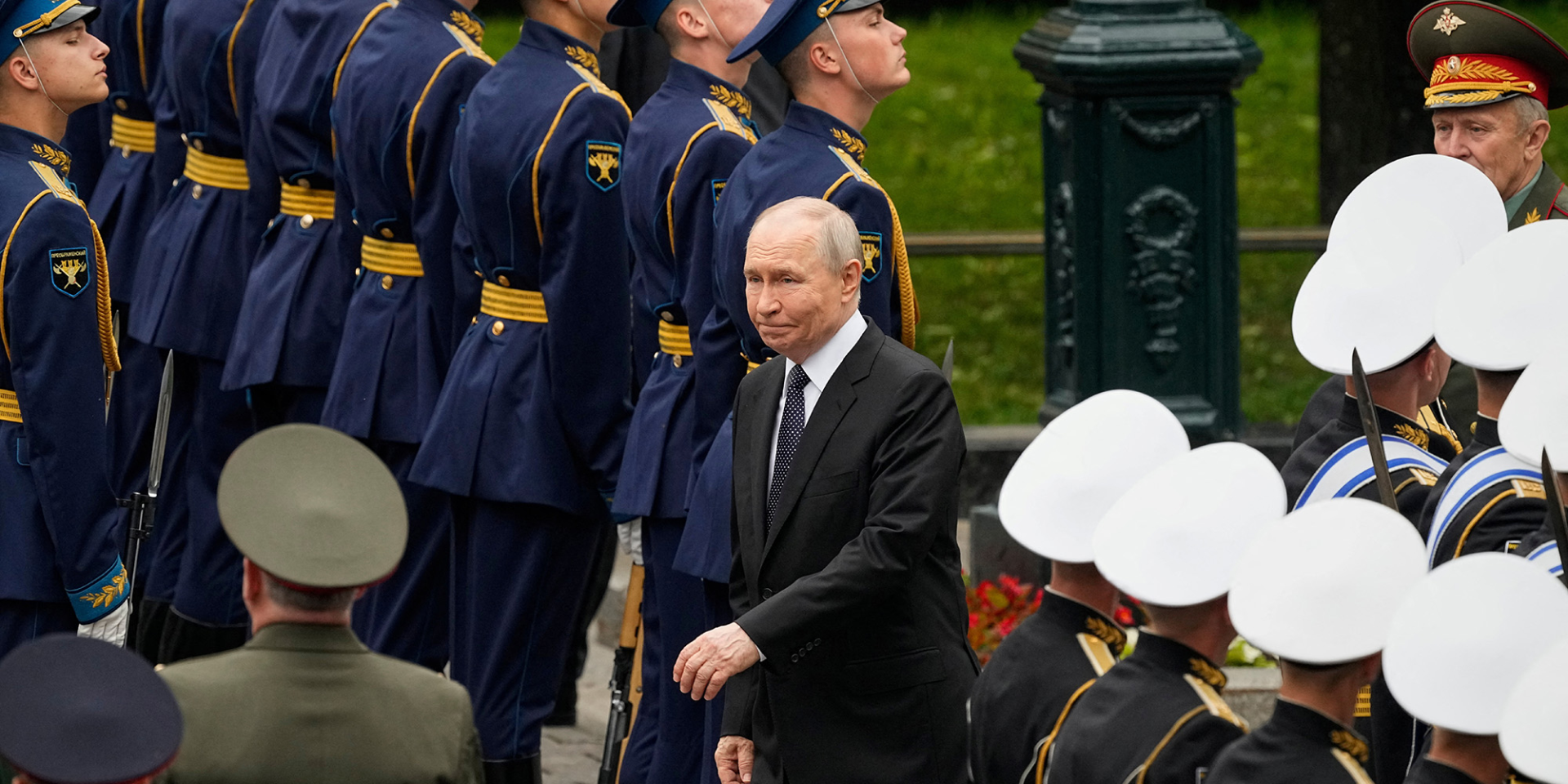
Kremlin prepares for possible new mobilization wave as Ukrainian intelligence says Russia could call up 300,000–500,000 people this fall (Photo: Reuters)
Russia could mobilize as many as 500,000 people as early as
this fall. But a larger army could create serious military, economic and
political problems for the Kremlin.
“Putin is preparing for mobilization,” “the Kremlin will
announce another mobilization wave in the fall,” and “Putin could launch a new
offensive in northern Ukraine starting in February 2027 if he mobilizes by
then” — reports like these spread widely in the Ukrainian information space
over the summer, citing President Volodymyr Zelenskyy, Western intelligence
agencies and senior Ukrainian intelligence officials. They also spread beyond
Ukraine.
Russian opposition media began reporting on a possible
second mobilization wave. In the second half of July, some outlets reported
that conscripts from Russia’s Perm region were forced to sign Defense Ministry
contracts while still traveling to their units. Novaya Gazeta Europe reported
that recruiters were pressuring conscripts with a simple argument: “Sign now
while they are still paying, because mobilization could begin soon and then
they will take you for free.”

Mobilization, a subject the Kremlin has tried to avoid
discussing since 2022, is again receiving widespread attention.
During the first seven months of 2026, Russian military
casualties reached an estimated 225,500, exceeding the total number of contract
soldiers recruited — 221,000 out of an annual target of 409,000 — for the first
time, according to the Institute for the Study of War. Bloomberg reported in
February, citing Western officials, that Russian losses had exceeded
recruitment for three consecutive months.
Ukraine’s military intelligence has presented a similar
assessment using separate estimates. Russia recruited 195,000 people from
January through July but lost 196,700 troops over the same period, HUR
spokesperson Andrii Cherniak said.
The Russian occupation force in Ukraine totaled 721,000
service members in June, according to an estimate by Oleksandr Syrskyi, who was
then commander-in-chief of Ukraine’s Armed Forces.
The figures suggest Russia would need significantly more
personnel if it is to try to fulfill Putin’s demand to capture all of the
Donbas next year.
After the ‘elections’
Russia is scheduled to hold State Duma elections on Sept.
18–20. Western and Ukrainian analysts expect the Kremlin to avoid unpopular
measures before the vote, making the period afterward a more likely window for
any decision on mobilization.
Putin plans to mobilize between 300,000 and 500,000 people,
with the active phase potentially beginning in October, Zelenskyy told Sky News
on July 27, citing Ukrainian intelligence.
Zelenskyy provided more detail on Aug. 11, citing a report
from HUR chief Oleh Ivashchenko.
“Everything is confirmed by internal Russian documents. They
are preparing it for the fall, immediately after the imitation parliamentary
elections,” Zelenskyy said.
The preparations can be seen in the details, military
analyst Viktor Kevliuk told NV. Russia’s General Staff has already compiled
lists of people to be called up, and authorities are denying them passports for
foreign travel under various pretexts, he said. Russia also expanded the list
of Criminal Code offenses in late July that allow prisoners to be sent to war.
“Overall, the Russians have prepared all the paperwork so
that, if the decision is made, they can close the borders, suppress protests,
cut off the internet and gather the required number of people,” Kevliuk said.
The Kremlin continues to publicly deny that another
mobilization is planned. Putin spokesperson Dmitry Peskov insisted in March
that “this issue is not on the agenda.” Putin also said: “There is no need to
conduct mobilization. We are not planning it.”
State Duma defense committee chair Andrey Kartapolov
promised that the Russian military would grow to 2.39 million personnel
“exclusively on a contract basis.”
Yet on Feb. 17, 2022, exactly one week before Russia’s
full-scale invasion, Peskov called reports of the planned attack date “another
fake” and described Western warnings of an assault on Ukraine as “ostentatious
hysteria based on nothing.”
The Russian opposition outlet Verstka reported on July 27,
2026, that eight of its sources in the Russian presidential administration and
military enlistment offices had heard about a possible new wave in the fall.
The Kremlin would not necessarily need to issue a new public
mobilization decree. Putin’s Sept. 21, 2022, decree announcing “partial”
mobilization was never revoked and remains dormant. Russia also has an
electronic registry of people liable for military service and the BARS
territorial reserve, allowing recruitment to be organized without a new public
order.
Russian human rights advocate Sergei Krivenko, director of
the Citizen. Army. Law group and a board member of the international Memorial
organization, has also said a “separate, possibly secret presidential decree”
could be issued.
Russian opposition politician and economist Vladimir Milov
has proposed a different scenario. He believes a new wave would not rely on
military enlistment office raids but would instead operate through businesses.
People are easiest to mobilize from places where they are
“anchored” — jobs they cannot leave, Milov said. Companies would receive quotas
specifying how many men they must “hand over,” and managers would decide whom
to sacrifice. Such a system would require no public mobilization announcement.

The arithmetic of war
Contract recruitment provides Russia with 30,000–35,000
people a month, according to Bloomberg estimates. That is still enough to
replace about 9,000 troops killed each month, based on calculations by Janis
Kluge of the Berlin-based SWP institute.
But that recruitment rate would be insufficient to replace
total monthly casualties at the level required for anything beyond slow,
grinding advances. An anonymous Russian general told The Moscow Times that
Russia would need to replace 55,000–60,000 casualties each month to capture the
entire Donbas. He therefore considers mobilization entirely possible.
The financial incentives Russia has used to attract contract
soldiers are becoming less effective. The federal payment for signing a
contract is 400,000 rubles, or $4,700. Regional bonuses reach 3.55 million
rubles, or $42,000, while total one-time payments can reach 4 million–4.5
million rubles, or $47,000–$53,000, Kevliuk said.
Some Russian regions, however, are facing serious budget
problems. The poorest regions have also exhausted much of the pool of people
motivated primarily by the payments, Kevliuk said.
“Those who do not really need the money are the ones left,
and they are in no hurry,” he added.
Russian economist Vladislav Inozemtsev, who calls this model
“deathonomics,” told Novaya Gazeta Europe that the system has exhausted itself.
The state pays more for a person’s life than the total value of everything that
person produces through work, while the pool of willing recruits is
disappearing from prisons, pretrial detention centers and economically
depressed regions. The rest of society is not prepared to die in a trench, even
for large sums of money, he said.
Inozemtsev put the probability of mobilization at about 30%.
His main argument in favor of that possibility was not military logic but what
he described as Putin’s loss of rationality. Putin’s unrealistic conclusions,
Inozemtsev said, lead to irrational decisions.
A struggle is underway within the Russian government,
according to Kevliuk. The General Staff is pressing for mobilization because
there has been no progress on the battlefield, while Putin’s administration is
warning him of a possible social explosion. So far, the administration has
persuaded him that mobilization is unnecessary, Kevliuk said.
Michael Kofman of the Carnegie Endowment assessed the
likelihood of Russian mobilization as low but rising. It is already too late
for mobilization to affect the 2026 campaign, he said. Any such move would
amount to expanding the army for 2027. If Russia cannot maintain the flow of
recruits, its frontline units will begin to shrink.
Washington Post deputy editor David Ignatius put the odds at
50-50.
“Putin will either mobilize or seek a way out through
Trump,” he said.
How Russia could use mobilized troops
What Russia would do with hundreds of thousands of mobilized
troops can be assessed by examining how it currently uses contract soldiers.
Only about 30% of those called up would receive proper
training with the facilities now available, Kevliuk said. They would form
strategic reserves, primarily as paratroopers, marines and specialists in
certain branches of the military.
The remaining two-thirds would be sent directly to the
combat zone. They would receive 10–14 days of “accelerated training” at
rear-area divisional ranges before joining first-echelon assault battalions.
Every Russian brigade has a motorized rifle regiment that
serves as an intake unit, Kevliuk said. Replacements arrive there before being
sent into infiltration groups on one-way missions. At the front line, those
groups are destroyed and replaced with newly mobilized troops, he said.
“Russian forces are prepared to consume human resources
without limit, like a meat grinder consuming pieces of meat,” Kevliuk said.
Mobilization would not change the nature of the war, in his
assessment. There are currently 150–250 combat engagements along the front each
day. It is a “squad-level war,” with groups of two to five service members
carrying out attacks. That general pattern would continue.
Kevliuk said the greater danger is that Russian forces could
build a numerical advantage in selected areas and overwhelm Ukrainian
positions. They previously used that approach near Pokrovsk, Avdiivka and
Bakhmut, where Ukrainian troops were at times outnumbered 20 to one.
Russia currently lacks the personnel to create that kind of
advantage, but mobilization could change that.
Even so, difficult terrain and the extensive drone kill zone
would prevent Russian forces from turning localized tactical gains into an
operational breakthrough, Kevliuk assessed.
Russia’s objectives are known, he said: occupying Donetsk
Oblast and increasing pressure in the Zaporizhzhya area by moving close enough
to the city to “take it hostage using the Kharkiv model,” allowing Russian
forces to strike it with every available weapon.

Kevliuk said those are the areas where Russian commanders
would likely deploy large numbers of newly mobilized troops.
That assessment is consistent with Bloomberg’s February
forecast of an offensive against Donetsk Oblast’s “fortress belt” or a renewed
assault on Zaporizhzhya.
Kevliuk rejected the prospect that the Kremlin could use a
newly mobilized force to open another front.
“It would be destroyed before it even began carrying out its
missions,” he said.
Kevliuk said winter conditions would not fundamentally alter
the balance. Frozen ground and rivers would simplify Russian logistics, but
snow-covered Ukrainian minefields would offset that advantage.
The economic cost of mobilization
A new mobilization wave would impose significant additional
costs on the Russian budget and could prove unaffordable under the current
compensation system.
Over the past 12 months alone, Russia’s state budget has
paid more than 4 trillion rubles, or $47.3 billion, in bonuses, salaries and
death benefits to occupation troops, Inozemtsev said. Death benefits consumed
half of that total.
The Russian budget could not support another 500,000 people
on the same terms, he said. Mobilizing people without paying them at comparable
rates would create a sharp divide between contract soldiers receiving 200,000
rubles, or $2,400, a month and those forced into service without equivalent
compensation.
Mobilization is one of the few foreseeable scenarios capable
of destabilizing Putin’s regime from within, Inozemtsev said.

“There is no more powerful way to shoot yourself in the
foot,” he said.
Milov believes mobilized troops would be placed on the same
footing as contract soldiers and would have to receive at least 195,000 rubles,
or $2,300, a month.
Even 300,000 recruits would cost the Russian budget more
than 700 billion rubles, or $8.3 billion, a year at the minimum rate. With
additional payments, the cost would exceed 1 trillion rubles, or $11.8 billion.
The publicly disclosed personnel spending line in the
Russian Defense Ministry’s budget has already risen 2.5-fold, from 600
billion–700 billion rubles, or $7.1 billion–$8.3 billion, before the 2022
mobilization to a planned 1.84 trillion rubles, or $21.8 billion, in 2026.
Milov recalled that the 2022 mobilization triggered a “wage
race” in Russia. Businesses competed for scarce workers, driving inflation.
Russia has still not emerged from three years of high benchmark interest rates
that have constrained lending, while the Russian central bank has identified
labor shortages as a key cause of the cycle.
A new mobilization wave would come at a time when Russia’s
economy is already under greater pressure. Coal producers, steelmakers,
farmers, Wildberries, which has suffered damage in drone attacks, and Rostec,
which is seeking money from the Russian government, are already seeking
trillions of rubles in budget support.
Russia has no more than 8 million men ages 20–30, about 6
million fewer than 15 years ago. The average age of Russian service members
killed in the war whose names have been confirmed by the BBC and Mediazona has
reached 43 and continues to rise.

An army increasingly composed of men in their 40s would face
limitations in a drone-intensive war, Milov said, and mobilization would not
resolve that problem.
Even a mobilization of 1 million troops would not, in
Kevliuk’s assessment, solve the Kremlin’s broader strategic problem.
“Gathering a million people is not a problem for the
Russians. The question is what to arm them with, how to train them and how to
get them to the front without our forces wiping them out while they are still
moving into position,” Kevliuk said.
Strategic objectives require strategic action, and attacks
by groups of two do not qualify, he said.
“Having enormous resources does not mean those resources can
be used rationally,” Kevliuk added.
Kevliuk therefore believes Russia will still covertly
mobilize about 100,000–200,000 people liable for military service and use them
to bring its occupation force up to strength.
After that, he expects the Kremlin to continue its slow,
grinding campaign in Donetsk Oblast.
“The enemy does not have the strength, resources or
operational imagination for anything else,” Kevliuk concluded.
The military war may be swinging in our favor, but the information war continues.
Just as an army needs soldiers, so does a free society need its journalists to ensure that people have access to honest, trustworthy voices to understand the world around them.
For the past five years, The New Voice of Ukraine has been working tirelessly to push back against Russian narratives and defend democracy. But we cannot do it alone.
Please consider supporting us on Patreon for just $5 a month – your donation does directly to supporting journalists and ensuring that this front of the infowar says solid and defended.
Thank you.
Follow us on Twitter, Facebook and Google News
