


The history Poland and Ukraine never learned to talk about — opinion
 Read NV on Google
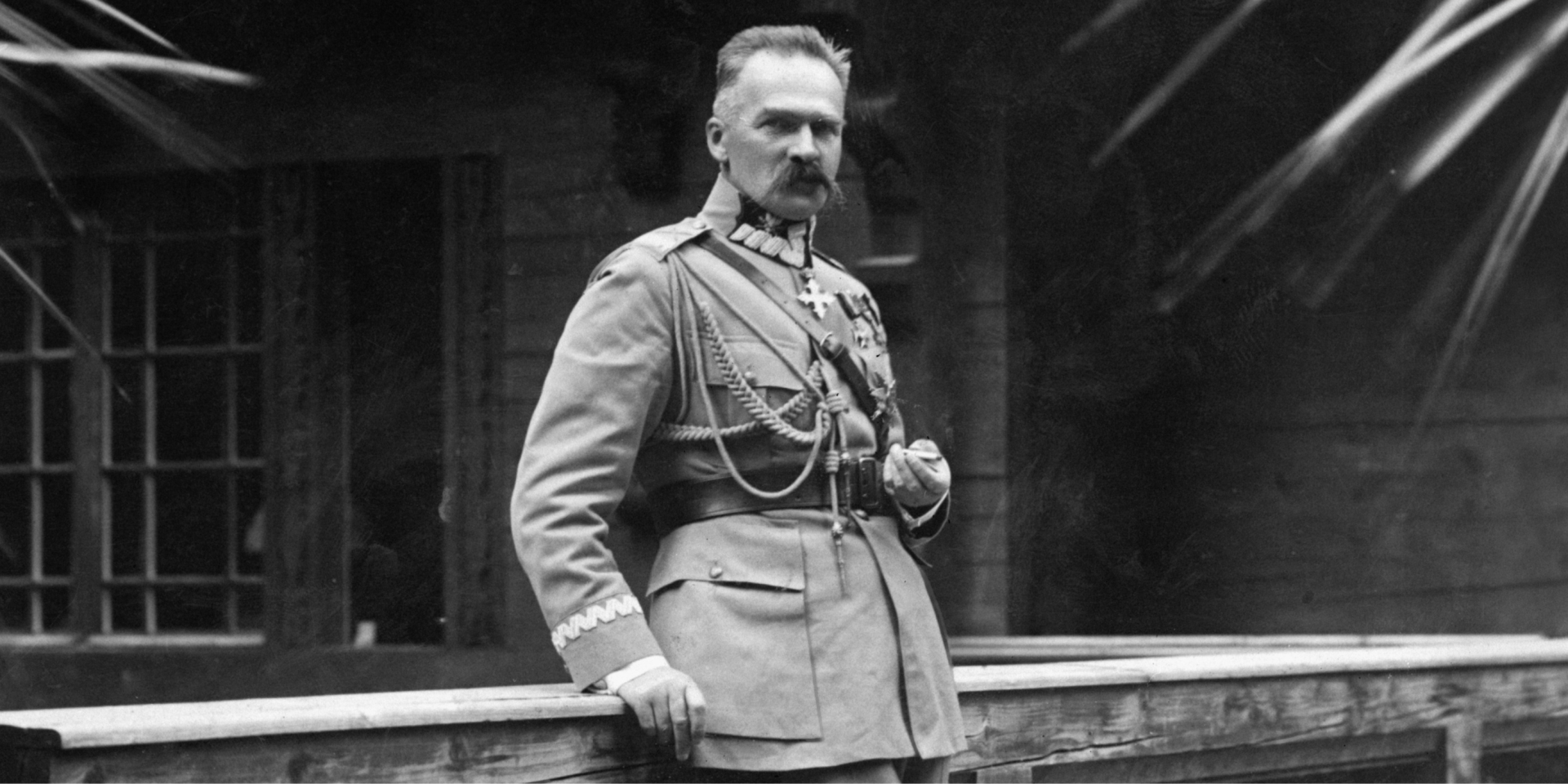
Józef Piłsudski (Photo: Bettmann / Getty Images)
For
many Poles, the defining historical wound in their relationship with Ukraine is
the Volyn tragedy. For many Ukrainians,
the period that precedes it — the interwar years, when much of western Ukraine
was part of the Second Polish Republic — is an equally important part of the
story, but one that remains poorly understood in Poland.
That
asymmetry in historical memory is one of the reasons why arguments between
Poles and Ukrainians so often appear to start in the middle of the story.
Lukasz
Wojtkowski, a Polish researcher specialising in disinformation and information
warfare, believes that one of the roots of today's Polish-Ukrainian historical
conflict is that many Poles simply know too little about what happened on
Ukrainian territories between the two world wars.
“We
take the 20 years between 1919 and 1939 as a part of the resurrection of
Poland, the great Polish society, the great Polish state,” Wojtkowski says. “We
tend to bleach it a bit, to show it as a bit brighter than it was.”
For
Ukrainians, the interwar period is inseparable from questions of Polish rule,
discrimination and the Pacification policy such as the suppression of Ukrainian
political and cultural aspirations, closures or destructions of Ukrainian
institutions, and mass arrests and murders of Ukrainian activists.
For
many Poles, meanwhile, the story of Ukraine in the 20th century is instead
dominated by the Volyn tragedy and the memory of Polish civilians killed by
Ukrainian nationalist forces.
“The
Volyn events are still an open wound for many Poles who share family history of
that experience,” Wojtkowski says. “But at the same time, Poland has a homework
to do when it comes to understanding what Polish rule meant for Ukrainians
before the Second World War.”
That
unfinished historical conversation has become a part of a much wider political
argument over Ukrainians in Poland as well as a source for information warfare.
A history that travels well online
“Most
of the posts on this subject in the Polish infosphere are posts inciting Poles
to hatred toward Ukrainians.”
For
Anna Mierszynska, a Polish researcher who studies disinformation, that is the
dividing line from a difficult historical argument. The existence of
disagreement over Volyn, she stresses, is not itself evidence of manipulation.
A genuine debate involves listening to both sides, considering new evidence and
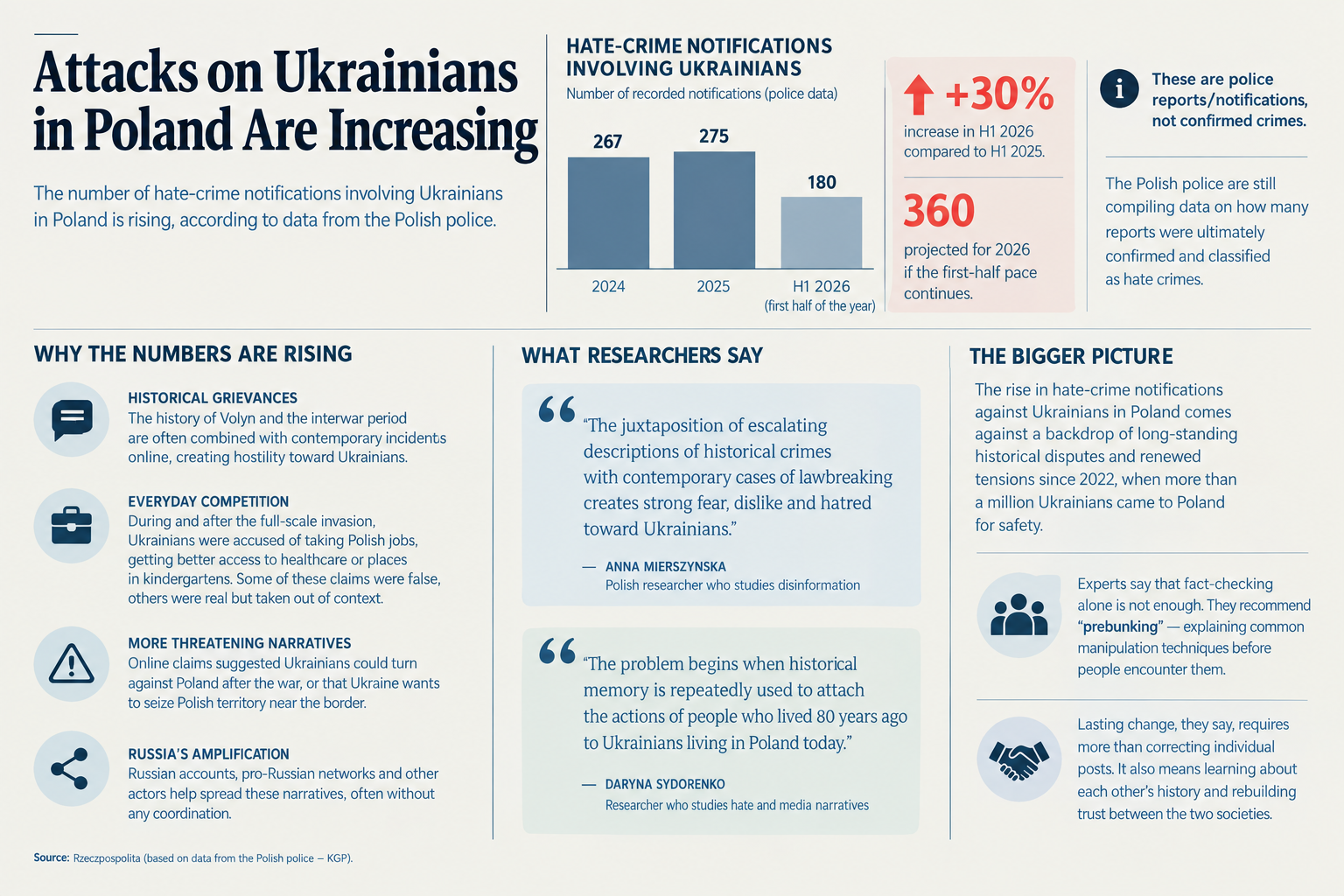
trying to explain what happened. The problem begins when historical memory is
repeatedly used to attach the actions of people who lived 80 years ago to
Ukrainians living in Poland today.
The
technique is simple but emotionally powerful. Posts describing the murder and
suffering of Polish civilians during the Volyn massacres are placed alongside
reports about crimes allegedly committed by Ukrainian citizens in contemporary
Poland. Some of those reports are false; others may concern real incidents but
are presented without the context needed to understand them.
“The
juxtaposition of escalating descriptions of historical crimes with contemporary
cases of lawbreaking creates strong fear, dislike and hatred toward
Ukrainians,” Mierszynska says.
While
the Polish-Ukrainian grievances were put aside in the beginning of the Russian
full-scale invasion, they reappeared in the following months as more than a
million Ukrainians moved to Poland for safety reasons. During this period, some
of the most persistent claims focused on competition between Ukrainians and
Poles in everyday life. Ukrainians were accused of taking Polish jobs,
receiving preferential access to doctors or occupying places in kindergartens
that should have gone to Polish children. Mierszynska says these stories
frequently took real problems in Poland, such as long healthcare waiting lists,
and assigned responsibility for them to Ukrainian refugees.
“They
blamed Ukrainian refugees for problems that already existed in Poland,” she
says.
The
newer narratives are more explicitly threatening. Ukrainians are increasingly
presented as a criminal or physical danger, while Volyn is used to construct a
bridge between historical violence and imagined future violence. One recurring
claim is that Ukrainians may turn against Poland after the war with Russia
ends. Another suggests that Ukraine wants to seize Polish territory near the
border.
These
claims aim to create insecurity and work with existing traumas such as the
memory of the Volyn events. In addition to spreading hatred in the Polish
society, they can also be used within Ukraine to stir hatred toward Poles. If
Ukrainians encounter Polish political rhetoric about Volyn without any
acknowledgement of the interwar history of Ukrainian life under Polish rule or
post-Volyn retaliations, they may conclude that Poland's historical memory
leaves no room for Ukrainian suffering. That can deepen Ukrainian distrust and
make hopes of further reconciliation harder.
Russian amplifier
Russia
benefits from this gap in neighbors’ histories although it did not create it.
“There
is a high level of activity by pro-Russian environments, Russian accounts and
influencers on social media around these issues,” Mierszynska says. Researchers have observed similar
anti-Ukrainian messages appearing across Russian Telegram channels, Russian
state media, pro-Russian activists in Poland and parts of the Polish far right.
“However,
it is not important whether the content is distributed by Russian actors
themselves or whether they only inspire particular groups in Poland,”
Mierszynska says. “What matters is the result.”
A
Russian account can introduce a narrative, but then, it is a Polish political
actor who may be repeating it because it resonates with voters. Further, these
narratives can be picked up by influencers as controversial content generates
attention, and then average users may engage with it because it confirms
something they already believe. None of those people need to have coordinated
with one another for the narrative to spread.
Wojtkowski
describes the process as a “playbook” in which Russia amplifies conflicts that
already exist between the two societies. Volyn is especially useful because it
can activate Polish anger about Ukrainian nationalism while simultaneously
supporting the Kremlin's portrayal of contemporary Ukraine as a country
supposedly dominated by nationalist or “fascist” forces.
“Volyn
is a playbook for propaganda and disguised disinformation,” he says. “It is the
only open case between those two nations that could spark the engine of
disinformation and hatred.”
The
symbolism of Stepan Bandera makes the subject even more combustible. In Poland,
Bandera is strongly associated with Ukrainian nationalism and the crimes
committed by Ukrainian nationalist forces. In Ukraine, parts of his legacy
remain connected to the struggle for independence from foreign domination.
Wojtkowski notes that Bandera himself was imprisoned in 1941 and was not
directly involved in the Volyn massacres, but this detail does not change how
politically loaded his figure has become.
Poland
and Ukraine have made progress on exhumations and commemorations of victims.
Yet Mierszynska says that some groups that repeatedly demanded exhumations
appeared less interested in historical resolution than in maintaining an
anti-Ukrainian argument.
“It
turned out that for these groups it did not matter,” she says. “It was a false
argument, not an element of a genuine debate.”
Wojtkowski
makes a similar point from another direction. Even a breakthrough in which both
countries acknowledged crimes committed against the other, completed
exhumations and established a shared framework for commemoration would not
necessarily end the political conflict.
“Imagine
that in two weeks Poland and Ukraine commemorate every victim,” he says.
“Ukraine admits that they killed so-and-so, Poland admits what we did,
everybody is exhumed. Would it change a thing? I doubt it.”
When media becomes part of the mechanism
The
boundary between propaganda and ordinary journalism is another part of the
problem, says Daryna Sydorenko, Senior Advisor at the Alliance 24/08 NGO and
Coordinator of “Observatory of Hate – See. Monitor. React.” Over the past two
years, she says, negative reactions to stories involving Ukrainians have
intensified across Facebook, TikTok, Telegram and even LinkedIn.
“The
mention of Ukraine and Ukrainians is always accompanied by such heavy
emotions,” Sydorenko says, describing anger and aggression that now appear even
underneath relatively neutral stories. Her project tracked how messages about
Ukrainians moved from Polish-language Telegram channels into the wider media
environment, while also monitoring physical attacks against Ukrainians as an
extreme manifestation of that hostility.
Telegram
was particularly useful for following this process because it acts as an
aggregator.
“On
these Telegram channels you could really find a collection of all the
information from TikTok,” Sydorenko says. The channels brought together videos,
news, political statements and material from other platforms, making it
possible to see which politicians and messages were being repeatedly
highlighted.
The
result was often a much more hostile interpretation of otherwise ordinary
events. Sydorenko recalls one report about a Ukrainian soldier on leave in
Odesa who went into a courtyard and fired a starter pistol before threatening
to detonate a grenade. Nobody was injured and he was detained for hooliganism,
but the story was presented in an especially sensational way.
“The
editorial office was probably simply chasing sensationalism,” she says. “They
wanted to tell more about these kinds of moments because they attract readers'
attention.”
The
problem, she adds, came when such stories were then combined with reports about
drug trafficking or crime.
“When
you put this together with the materials they selected about drug trafficking
or crime in general, of course it creates a certain image.”
Sydorenko
gives another example involving a cross-border operation against drug
laboratories. Posts on Polish-language Telegram channels presented the case as
evidence that Ukraine had become a hub for drug trafficking from Mexico and
that Ukrainian gangs were flooding Poland. In reality, she says, the operation
involved Ukrainian and Polish authorities working together to dismantle
laboratories; 36 were located in Ukraine, two in Poland and two in Moldova,
while Mexico had nothing to do with the operation described.
A
similar process occurred around a real article about changes to free health
insurance for Ukrainians. The original story discussed the potential
consequences for Ukrainians who might lose coverage, particularly vulnerable
groups such as pensioners. Most Ukrainians living in Poland as refugees are
employed, Sydorenko says, but the change could disproportionately affect those
who are no longer working. The article was subsequently reframed as evidence of
Ukrainian “ingratitude” towards Polish hospitality and the idea that Poland
should begin reducing that hospitality.
Building resilience beyond fact-checking
To
address these fakes and manipulations, researchers recommend going beyond
debunking and instead, focus on prebunking. This means explaining a
misleading narrative before it spreads widely. The public can be warned in
advance about the techniques being used to push a particular idea, allowing
people to recognise the manipulation when they encounter it rather than only
learning about it afterwards.
“When
it comes to false news and manipulative narratives, we need not only to analyse
them, but also to develop and deploy counter-narratives,” says Wojtkowski, “We
know what is happening, who is doing it, how often it happens, and we can even
predict what will come next. But this is where we have failed, both Ukrainians
and Poles because we are still not very good at countering these narratives.”
But
information literacy alone will not solve the deeper problem. Mierszynska
argues that emotional manipulation works precisely because it exploits existing
fears and distrust, meaning that debunking individual posts cannot repair a
relationship that has become politically toxic.
“We
will not build resilience if we act only at the information level,” the expert
says. “We need to build stronger relations between Poles and Ukrainians through
integration, getting to know one another and building trust. Both sides need to
work on this, including the Ukrainian diaspora in Poland. When we know and
trust each other, external influences have much less power. That is what we
need most today.”
For
Poland, that means remembering Volyn without treating contemporary Ukrainians
as collectively responsible for crimes committed generations ago. For Ukraine,
it means recognising the depth of Polish historical trauma without dismissing
every Polish concern as Russian propaganda. Both societies need enough
historical confidence to acknowledge the suffering of the other without
surrendering their own memory.
“Both nations need to do their history homework,” says Wojtkowski, “So besides capturing harmful narratives and developing counter-narratives, we must be bringing that response down to the level of everyday society.”
By
Anna Romandash and Nata Yasevych.
The military war may be swinging in our favor, but the information war continues.
Just as an army needs soldiers, so does a free society need its journalists to ensure that people have access to honest, trustworthy voices to understand the world around them.
For the past five years, The New Voice of Ukraine has been working tirelessly to push back against Russian narratives and defend democracy. But we cannot do it alone.
Please consider supporting us on Patreon for just $5 a month – your donation does directly to supporting journalists and ensuring that this front of the infowar says solid and defended.
Thank you.
Follow us on Twitter, Facebook and Google News
