

Graham-Blumenthal bill will not save Ukraine - NV interview
 Read NV on Google
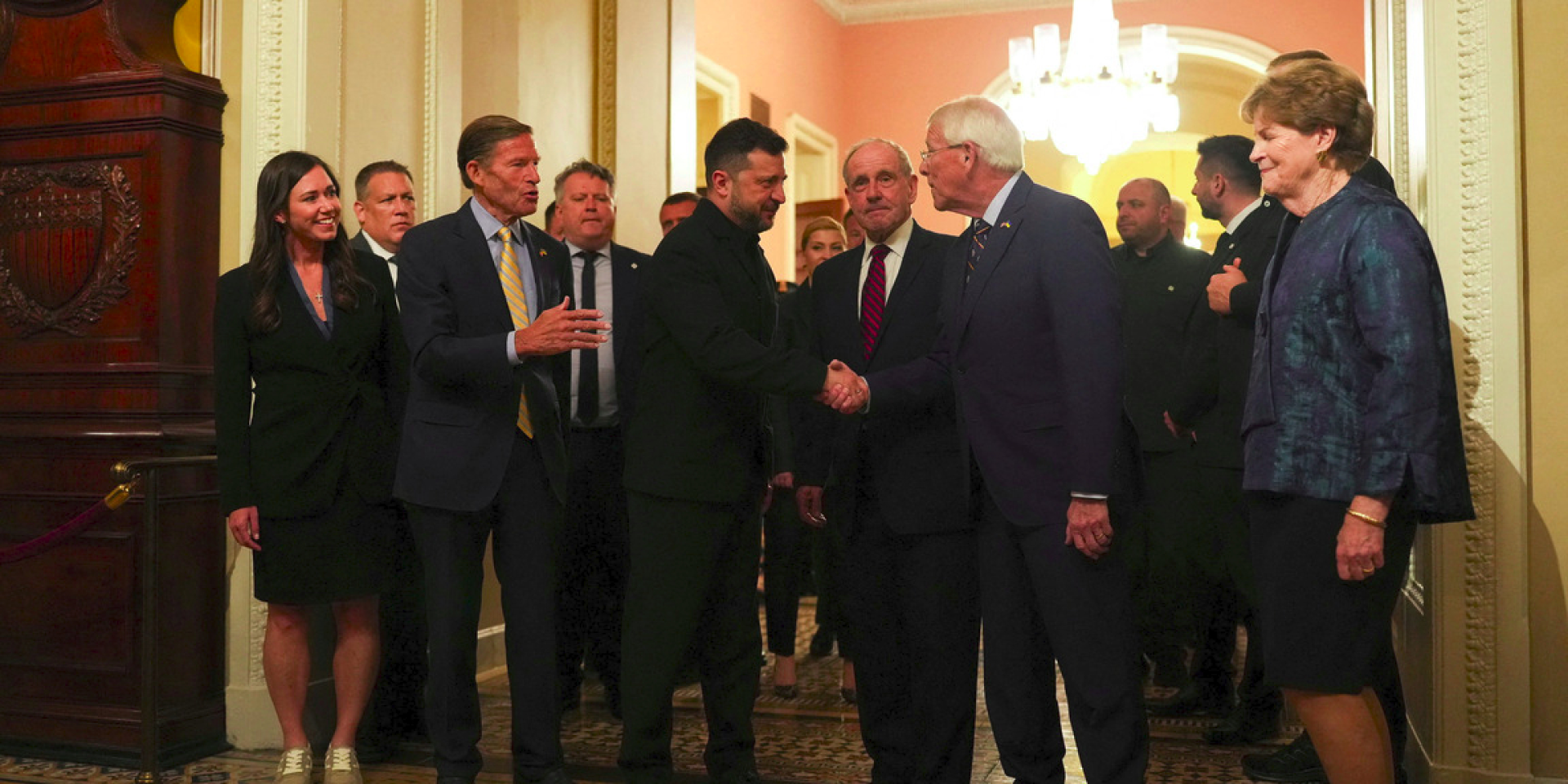
Volodymyr Zelenskyy at the meeting with U.S. senators on Graham-Blumenthal sanctions bill (Photo: REUTERS/Eric Lee)
The Graham-Blumenthal sanctions bill will not fundamentally change the war's outcome, Ukrainian journalist Roman Tsymbaliuk said on Radio NV on Sept. 17.
"If the Americans genuinely wanted to enact these sanctions, they would have done so long ago," he explained.
"In my assessment, the United States lacks the political bandwidth and resources for this. Significant volumes of Russian petroleum products are already blocked from transiting the Black Sea, and nothing is moving through the Persian Gulf either."
He emphasized that while the statutory framework targets primary buyers of Russian seaborne crude — specifically China, Iran, and India — international compliance remains dubious.
"Recent actions by the American president demonstrate that other global powers no longer pay serious heed to the United States on such foundational issues. If they had the resolve, they would have applied these penalties earlier. I understand that the Americans captured substantial global market shares as a byproduct of these conflicts, but one should not treat this bill as something that will fundamentally rewrite the board," the journalist explained.
Tsymbaliuk underscored that Ukraine's defense prioritizes immediate weapon deliveries over Western legislative debates.
"For a year and a half, they have been pouring from empty into void. The legislation merely grants the president discretionary authority to levy sanctions and import tariffs," Tsymbaliuk concluded.
"Yet whenever Donald Trump truly wants to impose tariffs, he already does so without hesitation. Therefore, I see nothing here that will dramatically transform the operational landscape."
Legislative passage of the Graham-Blumenthal act
Procedural Senate vote: On July 28, the U.S. Senate conducted an initial procedural vote on the legislation to impose fresh secondary sanctions on Russia and Iran, clearing the threshold with 86 senators voting in favor.
Senate passage: On Aug. 7, the Senate overwhelmingly approved the sanctions package by an 86–11 margin.
House approval: On Sept. 16, the U.S. House of Representatives formally passed the bill in a 262–159 vote.
Statutory penalties: The bill significantly ramps up legal pressure on Moscow, empowering the U.S. president to impose retaliatory tariffs of up to 100% against third countries continuing to import Russian energy resources. It further expands sanctions against senior Russian military commanders, financial institutions, energy conglomerates, foreign component suppliers, and shadow-fleet oil tankers, while tightening export controls on dual-use technology required for weapons manufacturing.
The military war may be swinging in our favor, but the information war continues.
Just as an army needs soldiers, so does a free society need its journalists to ensure that people have access to honest, trustworthy voices to understand the world around them.
For the past five years, The New Voice of Ukraine has been working tirelessly to push back against Russian narratives and defend democracy. But we cannot do it alone.
Please consider supporting us on Patreon for just $5 a month – your donation does directly to supporting journalists and ensuring that this front of the infowar says solid and defended.
Thank you.
Follow us on Twitter, Facebook and Google News
